
Industrial pumps are essential to daily operations across countless industrial plants, moving everything from water and wastewater to sludges, oil, food, and chemicals. With so many pump types available today, from industrial fluid pumps and vacuum pumps to submersible and dewatering pumps, industrial pump selection can feel overwhelming.
This guide breaks down the main pump types, their industrial pump applications, and the key factors to weigh before you buy. Before diving in, let’s quickly cover how these pumps actually work.
What are Industrial Pumps and How Do They Work?
Industrial pumps convert mechanical energy into hydraulic energy and transfer fluids from low-pressure to high-pressure levels.
The pump’s inlet tube sucks in the fluid. Once inside the pump, the fluid is moved by a rotating impeller, which increases the fluid’s velocity and pressure and directs it to the pump’s outlet.
12 Industrial Pump Types and Their Applications
Here are some of the main types of industrial pumps, their characteristics, and applications:
Centrifugal Pumps
This dynamic pump type uses one or more impellers directly attached to the shaft. It’s suitable for low viscosity fluids at high flow rates.
Centrifugal pumps are widely used in the chemical industry to move fluids with solid particles.
Centrifugal vs Positive Displacement Pump
One of the first decisions in any industrial pump selection process is choosing between centrifugal and positive displacement designs. Centrifugal pumps rely on impeller speed to generate flow, making them best for low-viscosity, high-flow, steady-pressure applications. Positive displacement pumps, including gear, lobe, diaphragm, piston, and screw pumps trap a fixed volume of fluid and force it through the system, making them better suited for viscous fluids, precise dosing, and applications where flow needs to stay constant regardless of pressure changes. Understanding the centrifugal vs positive displacement pump difference early on will narrow your options considerably.
ANSI Pumps
This centrifugal pump meets the standards of ANSI (the American National Standards Institute). These pumps have standardized dimensions and can be manufactured from various materials.
ANSI pumps are mostly used in the chemical and petrochemical industries.
1. Axial Flow Pumps
Driven by a sealed motor, axial flow pumps direct flow axially and perform well at low pressure and high flow rates. They’re used in flood dewatering, sewage digesters, and irrigation systems.
2. Vertical Pumps
Vertical pumps are used to draw liquid from deep wells. They are long and narrow, with multiple stages. They’re widely used in water transfer, dewatering, and draining applications.
3. Gear Pumps
Gear pumps are a type of positive dislocation pumps. They consist of gears that are driven by a motor. When the gears rotate, they create a suction void that carries the fluid.
These industrial fluid pumps are used to process clean thick fluids (like grease oil, paint, and fuel) in the chemical and petrochemical industries.
4. Lobe Pumps
Similar to gear pumps, but the lobes don’t touch directly, allowing them to move thick fluids containing solid particles. They’re widely used in the paper, chemical, food, and pharmaceutical industries.
5. Diaphragm Pumps
These use compressed air to create a vacuum and move fluid through pulsation. Because they run on pneumatic pressure, diaphragm pumps use less power, can run dry, and handle a broad range of viscosities, including volatile chemicals and fluids with hard particles. They’re popular in pharmaceutical, chemical, and food industries.
6. Piston Pumps
In this type of pump, the suction is created by a piston. Piston pumps are used in operations with high pressure or for transferring abrasive liquids.
Piston pumps are used widely in high water pressure operations such as automatic sprinklers and hydraulic pressure testing.
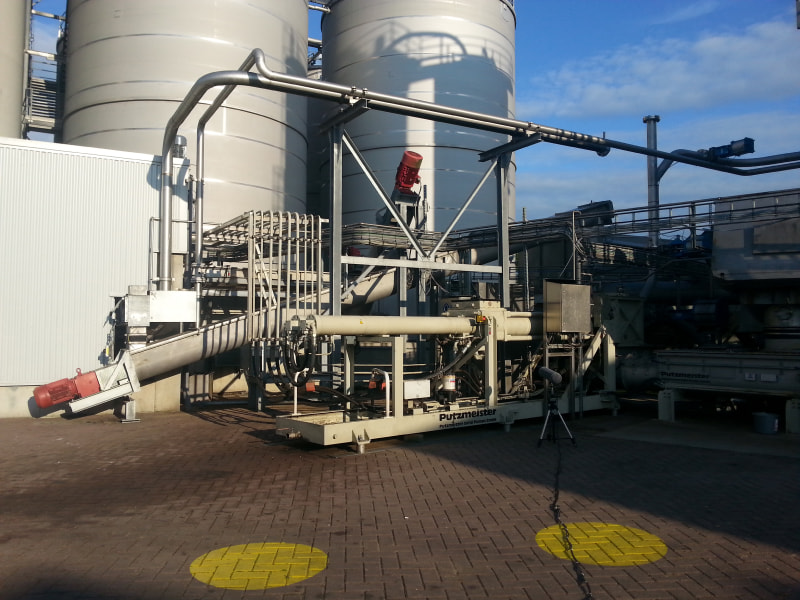
Peristaltic Pumps
The fluid in peristaltic pumps is transferred through a tube compressed with the help of rollers. This creates a vacuum that moves the fluid through the tube.
The advantage of this pump type is that the fluid in the tube is isolated from the pump’s mechanical parts, so the pump can’t contaminate the product.
That makes peristaltic pumps suitable for processing sterile fluids and aggressive chemicals.
Submersible Pumps
Submersible pumps are designed to operate submerged in the fluid they’re pumping. The motor is sealed in a protective casing to prevent any fluid from leaking in.
This type of pump is widely used in various water recycling applications.
Screw Pumps
Screw pumps create pressure with the help of two or more screws, which rotate in opposite directions. They’re used in high-pressure operations in the mining, oil, gas, and manufacturing industries.
Liquid Ring Vacuum Pumps
This positive displacement pump creates suction through the rotary motion of its impeller.
These industrial vacuum pumps are used in the food, mining, chemical, environmental, electrical, and marine industries.
Essential Industrial Pump Selection Considerations
Selecting the proper equipment requires evaluating more than just flow rate. Every industrial pump selection should consider the following factors.
Fluid Qualities
Begin by evaluating the liquid being pumped.
- Is it corrosive?
- Does it contain solids?
- Is it highly viscous?
- Does it operate at elevated temperatures?
- Is contamination a concern?
These characteristics determine the appropriate pump design, sealing method, and construction materials.
Construction Materials
Pump materials directly affect reliability and service life. Common materials include stainless steel, cast iron, bronze, duplex stainless steel, and specialty alloys selected to resist corrosion, abrasion, and chemical attack.
Flow Properties
Consider the flow pressure and the factors that might affect it. These include:
- Friction
- Elevation
- Kinetic energy
Based on that, you’ll be able to determine what pump mechanism is most suitable for controlling the fluid pressure and other properties.
Power Requirements and Availability
It’s important to consider the power source you’re using:
- Is it gas-powered or electrical?
- Are there any voltage constraints? If yes, how will they affect the pump performance?
- Do you need an electric pump, a pneumatic pump, or a mobile unit?
Select the Right Industrial Pump Type for You
For more insights on how to go about selecting the right pump type for your business, you can check our guide to pump selection.
And in case you need reliable industrial pump services, we at Houston Pump and Gear are ready to assist you. Our pump repair experts can answer all your questions and help you every step of the way, whether you need a routine maintenance check or a more serious repair.
Give us a call to get your custom quote today!