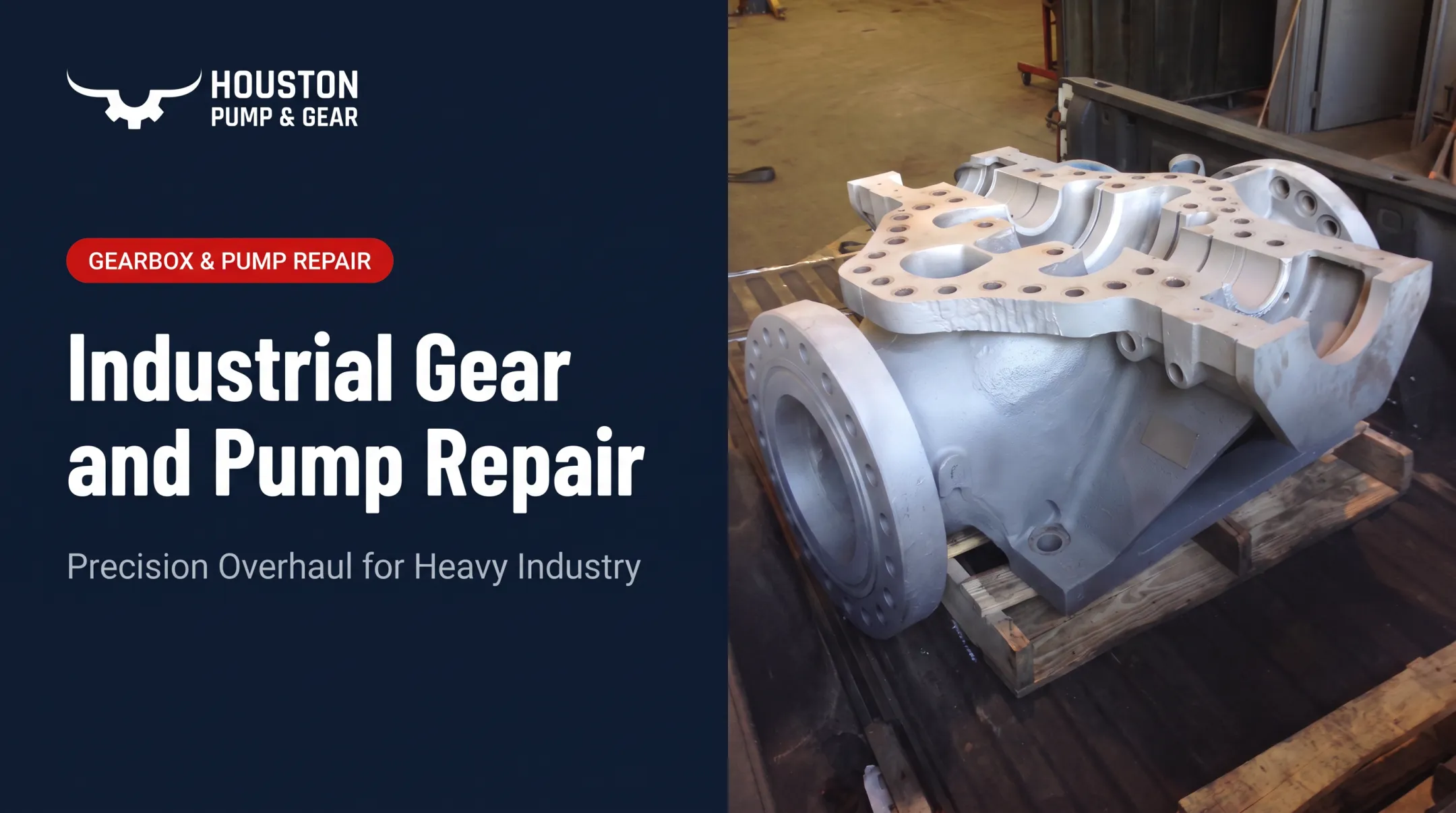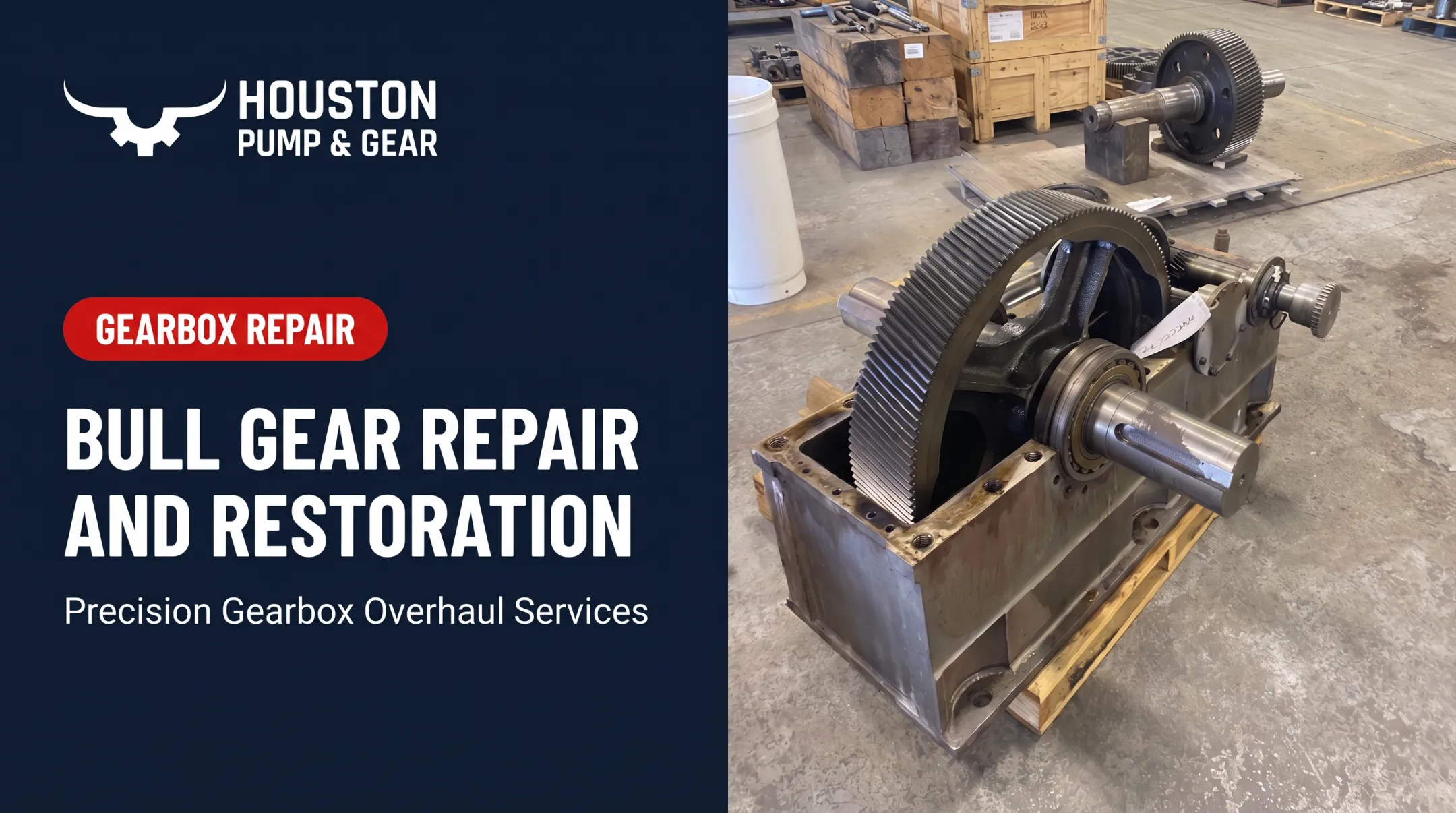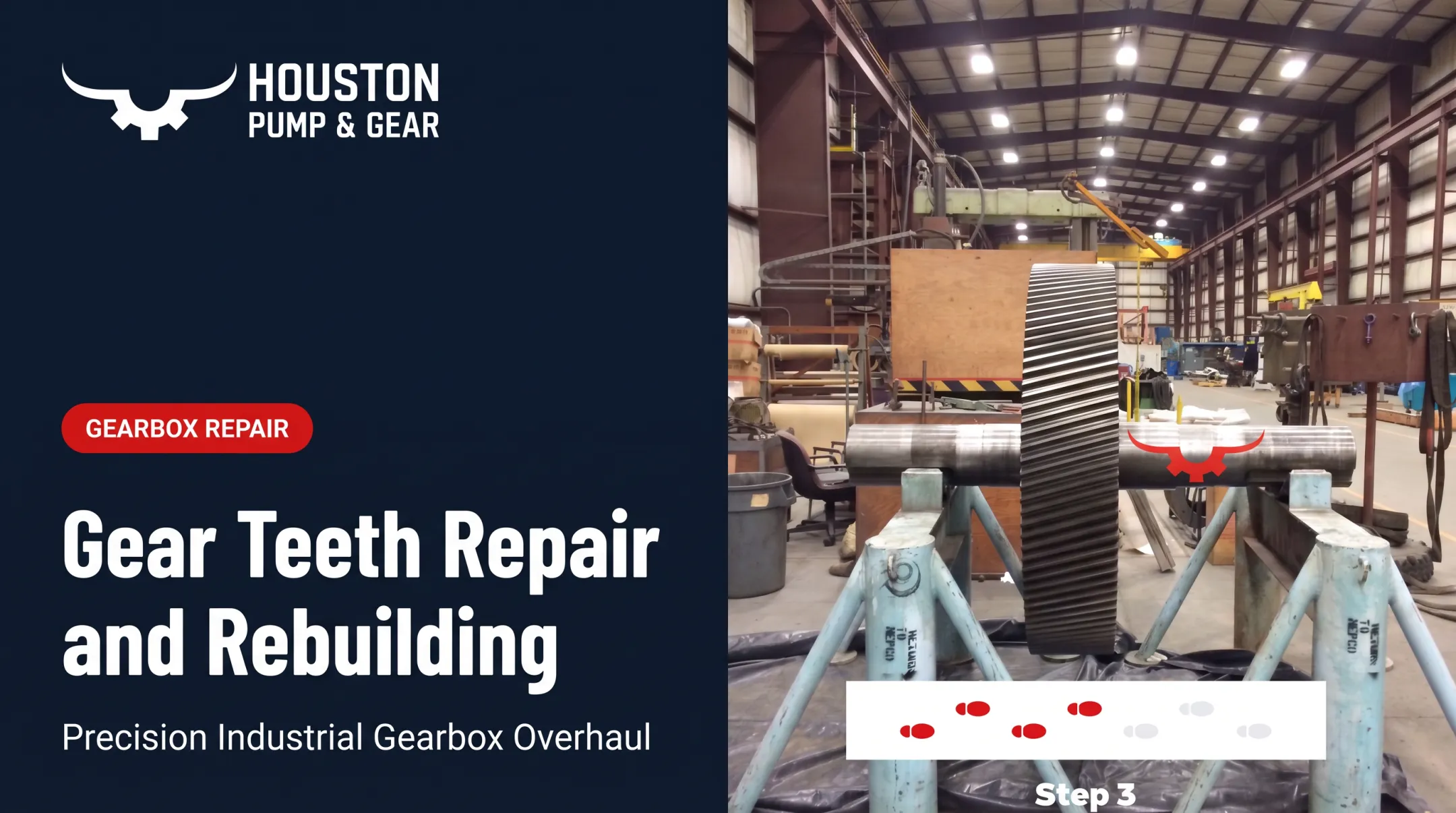

Gear damage rarely happens overnight. Fatigue cracks build for months, lubrication breaks down slowly, and misalignment creeps in after a bearing replacement nobody rechecked. By the time the noise or vibration shows up, the damage is often already advanced.
Houston Pump & Gear has spent years responding to exactly these emergencies — from a Lufkin S2212C failure that shut down a Texas power plant to after-hours breakdowns at heavy industry facilities across Texas and Louisiana. This article covers the most common gear failure patterns, a step-by-step repair process, how to decide between fixing and replacing a damaged gear, and when it's time to call in an emergency repair team.
Key Takeaways
- Most gears are repairable if caught early; cracked or heavily worn gears need replacement
- Failures follow four predictable patterns: tooth breakage, surface pitting, misalignment, and lubrication damage
- Reliable repairs need diagnosis, root-cause confirmation, the right method, and load testing before startup
- Emergency repair can restore critical gearboxes in days, not the weeks a full replacement often takes
Common Problems With Broken or Damaged Gears
A gear's job is simple: transmit rotational force, or torque, from one shaft to another at a controlled speed and direction. Inside an industrial gearbox, that force runs through hardened tooth surfaces millions of times a year. Most failures trace back to load, wear, lubrication, or installation history.
According to ANSI/AGMA 1010-F14, the industry standard for classifying gear tooth damage, most failures fall into tooth fracture, surface fatigue (pitting), wear, and cracking. Misalignment and housing distortion often drive those same damage modes in the field.
Broken or Chipped Gear Teeth
Symptoms:
- Sudden grinding noise or vibration spike
- Immediate loss of torque transfer
- Metal shavings visible in the lubricant
Likely causes: Shock loading, fatigue cracking, or a pre-existing micro-crack that finally propagated under normal operating stress.
Worn or Pitted Tooth Surfaces
Symptoms:
- Gradually increasing noise and vibration over weeks or months
- Reduced efficiency
- Visible spalling or pitting during inspection
Likely causes: Inadequate lubrication, contamination, or surface fatigue from sustained heavy loading.
Gear Misalignment or Wobble
Symptoms:
- Uneven wear pattern across the tooth face
- Unusual noise that only appears under load
- Premature bearing wear nearby
Likely causes: Improper installation, shaft deflection, or housing distortion.
Cracked Gear Hub or Rim
Symptoms:
- Visible surface cracks on inspection
- Abnormal noise at startup
- Progressive vibration as the crack grows
Likely causes: Material fatigue, thermal stress, or sustained overload beyond the gear's rated capacity—with high risk of sudden catastrophic failure if left unaddressed.

Why Gears Fail (Root Causes)
Every pattern above traces back to real operating conditions, not bad luck. Four factors show up again and again in industrial gear failures:
- Operational stress — continuous heavy loads, shock loading, or torque that exceeds the gear's rated capacity
- Environmental exposure — contamination, moisture, and temperature extremes common in power plants and heavy industry
- Improper installation — misalignment or incorrect shaft and keyway tolerances
- Maintenance gaps — infrequent lubrication checks and skipped inspections
Ignoring early warning signs rarely just means a noisier gearbox. Left unaddressed, gear problems compound quickly:
- Reduced efficiency and higher energy consumption
- Cascading damage to bearings, shafts, and housings
- Safety risks in high-torque equipment
- Costly unplanned downtime
That last point isn't abstract. A 2023 ABB survey of over 3,200 plant maintenance decision-makers found the median cost of unplanned downtime across industrial and power generation operations runs about $125,000 per hour.
More than two-thirds of respondents reported unplanned outages at least monthly. For a gearbox sitting between a motor and a critical process, that math adds up fast.
Gear Technology's analysis of systemic gear failures backs this up. Poor load distribution and misalignment raise stress at one side of the tooth long before a complete break. That damage usually shows up in vibration and oil data well before it turns catastrophic.
How to Fix a Broken Gear (Step-by-Step)
Fixing a broken gear without confirming what actually failed is how repeat failures happen. A grinding noise might point to a chipped tooth, but the real cause could be a misaligned shaft that will chew up the replacement just as fast. A reliable repair follows four steps: diagnose, confirm the root cause, apply the right fix, then test before returning the unit to service.
Step 1: Identify the Exact Problem
- Note visible symptoms: noise, vibration, metal debris in the oil, or visible tooth damage
- Track performance deviations: torque loss, overheating, or output speed fluctuation
- Document when the issue occurs: at startup, under load, or during continuous operation
Step 2: Confirm the Root Cause Category
Determine which failure category fits the evidence:
- Mechanical: tooth, hub, or structural damage
- Lubrication-related: film breakdown, wrong viscosity, dry running
- Alignment-related: shaft, housing, or coupling misalignment
- Contamination: debris, water, or seal failure
Rule out external factors as well. A failing motor, incorrect load rating, or bad coupling can all mimic gear damage. Skip this step and a facility can replace a sound gear while the real problem keeps destroying the next one.
Step 3: Fix the Gear Based on the Diagnosis
This is where the repair path splits—and where cost and errors climb if the wrong method is chosen.
Tooth or surface damage: Machine or weld-repair individual damaged teeth, or use insert/splice methods on larger ring gears. Resurface worn profiles only if the root fillets remain sound.
Lubrication or contamination damage: Flush and replace contaminated lubricant, inspect for pitting from inadequate film thickness, and verify seals and breathers so contamination does not return.
Misalignment or installation issues: Re-align shafts and housings with precision measurement tools, check keyway and fit tolerances, and confirm backlash and tooth contact pattern before final assembly.
Cracked or structurally compromised gears: Assess crack severity with non-destructive testing. Houston Pump & Gear uses X-ray and magnaflux inspection to catch cracks invisible to the naked eye. Grind out surface cracks when the structure is still sound; replace the gear if it is compromised.
Step 4: Test and Validate the Repair
Run the gearbox under normal and peak load conditions, monitoring noise, vibration, and temperature against expected benchmarks. Confirm the fix holds over a defined operating period before the unit returns to full production.

When Should You Fix vs Replace a Gear?
Every fix-or-replace call comes down to the same trade-off: cost, downtime risk, and long-term reliability. For power plant and heavy industry equipment, a wrong call means more than a repeat repair bill. It can mean another unplanned shutdown.
Isolated Tooth Damage on an Otherwise Sound Gear
Fix: Repair via insert or splice method when only one or two teeth are affected and the gear body is structurally sound. Replace: When multiple teeth across the gear show damage, replacement is usually the safer call.
Surface Wear With an Intact Structure
Fix: Resurface or recut worn teeth when the root fillets are still sound. Replace: Once wear has reduced tooth thickness below safe operating tolerance, repair stops being reliable.
Cracked Gear Hub or Rim
Fix: Repair only when the crack is confirmed superficial and doesn't affect load-bearing capacity. Replace: Immediately, if the crack is structural. The safety risk in high-torque applications isn't worth the gamble.
Custom or Legacy Gearbox Models No Longer in Production
Fix: Often the only realistic option, since OEM replacements for discontinued models can carry lead times measured in months. Replace: Worth considering only if a compatible aftermarket or custom-machined unit can be sourced faster than a repair.
A Texas power plant faced this with a Lufkin S2212C gearbox, a model with no quick OEM replacement path. When the unit failed and forced an emergency shutdown, Houston Pump & Gear dispatched a truck the same day.
The team brought the gearbox to its Houston facility and returned it fully repaired and tested 72 hours later. That same client has since had more than 15 additional units serviced by the team.
When to Call a Professional & How to Prevent Future Gear Failures
Complex industrial gearboxes, high-torque equipment, and emergency shutdowns typically need specialized tooling, testing, and expertise most in-house maintenance teams don't keep on hand. Bringing in a specialist earlier rather than later usually saves money.
Call in a professional when:
- The same failure keeps happening after previous repairs
- The equipment is safety-critical or high-torque
- The root cause isn't clear from a visual inspection alone
- An unplanned shutdown has already happened at a power plant or industrial facility
Houston Pump & Gear runs a 24/7 emergency line and a mobile pickup service with dedicated transport trucks, covering power plants and heavy industry across Texas and Louisiana. That 24/7 coverage and mobile pickup are why long-term clients come back for proven turnarounds instead of switching vendors mid-emergency.
Preventive Measures to Reduce Future Gear Failures
- Schedule regular inspections along with vibration and oil analysis to catch wear before it becomes catastrophic
- Maintain a consistent lubrication schedule and monitor for contamination
- Keep gears operating within their rated load and alignment specifications
- Train staff to document and report early warning signs, including noise changes and small leaks

For emergency support, call (832) 603-9663.
Frequently Asked Questions
Can damaged gears be repaired?
Most damaged gears can be repaired if the damage is limited to individual teeth or surface wear. Gears with structural cracks or widespread tooth loss usually need replacement instead.
What causes gear teeth to break?
Most common causes are shock loading, fatigue from repeated stress cycles, contamination, and inadequate lubrication. Misalignment also breaks teeth by concentrating stress unevenly across the tooth face.
How long does industrial gear repair typically take?
Turnaround depends on damage severity and gear size. In one emergency shutdown, Houston Pump & Gear completed a full gearbox repair and returned the unit to service in 72 hours.
Is it cheaper to repair or replace a broken gearbox?
Repair is usually more cost-effective for isolated damage or obsolete models with long OEM lead times. Replacement becomes the better economic choice once damage is extensive or failures keep repeating.
Can a gearbox keep running with a broken gear tooth?
No. Running equipment with a broken tooth risks cascading damage to adjacent teeth, bearings, and shafts. Stop the unit and inspect it as soon as possible.
How do you know if a gear needs replacement instead of repair?
Replace the gear if you see structural cracks, multiple damaged teeth, tooth thickness below safe tolerance, or repeated failures after prior repairs.