
Wear, contamination, bad installs, and skipped maintenance all lead to the same predictable failure patterns. Catch them early, and most rotary pumps are fully repairable. Miss the signs, and you're looking at emergency downtime.
This guide covers the common problems, root causes, a step-by-step repair process, and how to decide between fixing and replacing. We'll also cover when it's time to call a 24/7 specialist like Houston Pump & Gear.
Quick summary:
- Most rotary pump failures trace back to worn vanes, seals, bearings, or contaminated lubrication
- The majority of these issues are repairable, not replacement-worthy
- Repair follows four steps: identify, confirm root cause, repair, and validate
- Critical facilities need rapid-response partners for emergency turnaround
What Is a Rotary Pump?
A rotary pump is a positive displacement pump. It uses rotating components—vanes, gears, lobes, or screws—to trap fluid and move it through a system in a steady flow.
Two designs show up most often in industrial and power plant settings:
- Rotary vane pumps: A slotted rotor sits off-center in a cam-shaped housing. Vanes slide out, sweep fluid through the casing, then retract as the cam profile changes.
- Rotary gear pumps: Meshing gears trap fluid between the teeth and housing and carry it to the outlet. Best for clean, thick fluids like oil and grease.
- Rotary lobe pumps: Rotating lobes move thicker fluids and slurries with solid particles—common in food, paper, and chemical processing.

Like any mechanical system, these pumps degrade with hours of operation. Contamination and skipped preventive maintenance accelerate that decline.
Common Problems With Rotary Pumps
Rotary pump failures aren't random. They follow patterns tied to wear items, sealing, and lubrication quality.
Loss of Vacuum/Pressure Output
Symptoms: Fluctuating pressure, slow pull-down, reduced flow.
Likely cause: Worn vanes or rotors, internal leaks, degraded seals allowing internal slip-back.
Excessive Noise or Vibration
Symptoms: Grinding, rattling, shaft chatter.
Likely cause: Bearing wear, misalignment, or cracked internal components. Cavitation can cause the same symptoms, with a rumbling or gravelly sound from inadequate inlet conditions.
Oil Leaks or Contaminated Oil
Symptoms: Visible leaks, cloudy or burnt oil, oil that recontaminates quickly after a change.
Likely cause: Failed shaft seals or gaskets, or a lubrication system already compromised by debris.
Sluggish or Unresponsive Speed
Symptoms: Slow startup, inconsistent performance under load.
Likely cause: Low oil levels, worn drive components, or internal mechanical binding.
Left unchecked, these issues compound. Bearings overheat during prolonged operation and pick up metal shavings. Scrap metal in bearings, seals, or couplings means those parts need replacement, not just cleaning.

Why Rotary Pumps Fail (Root Causes)
Most failures link back to a few sources: operational stress, environmental exposure, improper installation, or maintenance gaps.
The pattern is consistent. A pump running past its service interval, or one that never had a scheduled inspection in the first place, is far more likely to fail unexpectedly than one on a maintenance plan.
Common root causes include:
- Inadequate NPSH (net positive suction head) or poor inlet conditions
- Suction-line leaks or excessive suction losses
- Incorrect rotation direction
- Relief-valve bypass
- Contamination or blockage in the fluid path
- Incorrect alignment or clearance
Left unchecked, early symptoms drive larger repair bills, safety and compliance exposure, and weaker product or process quality. They also turn a planned maintenance window into unplanned downtime, which almost always costs more than scheduled work.
Preventive maintenance intervals:
- Basic checks after every 8 hours of operation
- Full-service maintenance around every 250 hours
Facilities that follow this rhythm catch wear items before they damage bearings, shafts, or housings.
How to Fix a Rotary Pump (Step-by-Step)
Repairing a rotary pump without first pinpointing the exact problem is a common way to waste labor and end up with a repeat failure. The process below mirrors how experienced technicians diagnose and restore complex industrial units.
That same root-cause discipline is how Houston Pump & Gear handles emergency industrial repairs. On a Lufkin S2212C gearbox job, a truck was dispatched the same day and the plant was back online within 72 hours. Methodical diagnosis—not guesswork—made the turnaround possible.
Step 1: Identify the Exact Problem
Observe the symptoms (leaks, noise, vibration, output loss) and document when they occur. Startup? Under load? Continuous run? Check gauges and alarm readings against normal operating baselines.
Step 2: Confirm the Root Cause
Determine whether the problem is mechanical (vanes, rotors, bearings), sealing/lubrication related, or tied to environmental and operational conditions. Rule out external factors first:
- Power supply issues
- Incompatible fluid
- Ambient temperature extremes
Before opening the pump, isolate the driver and let it cool if leaks are present.
Step 3: Repair Based on Diagnosis
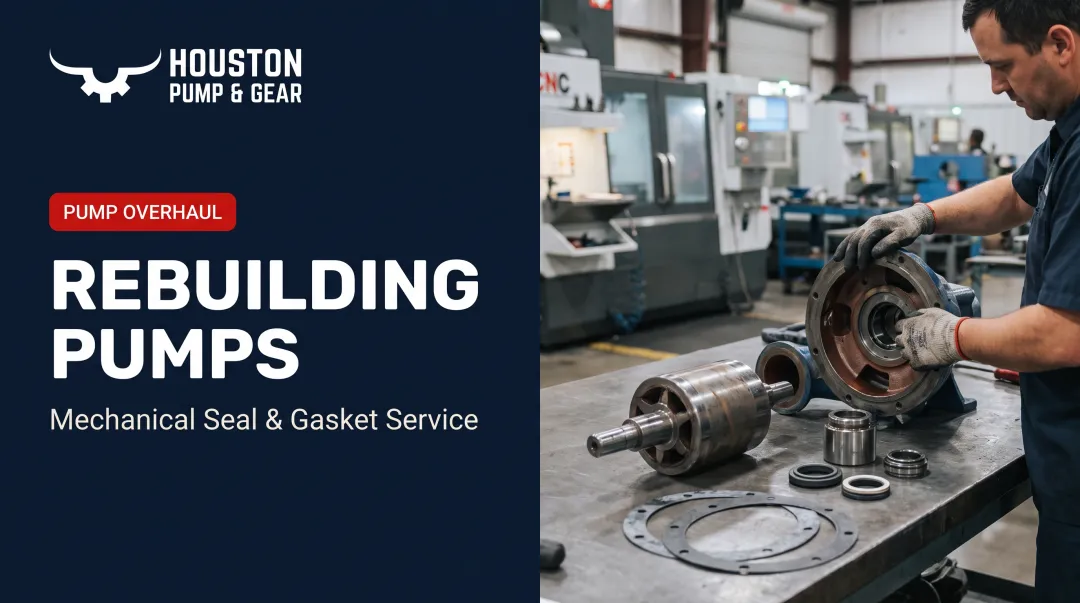
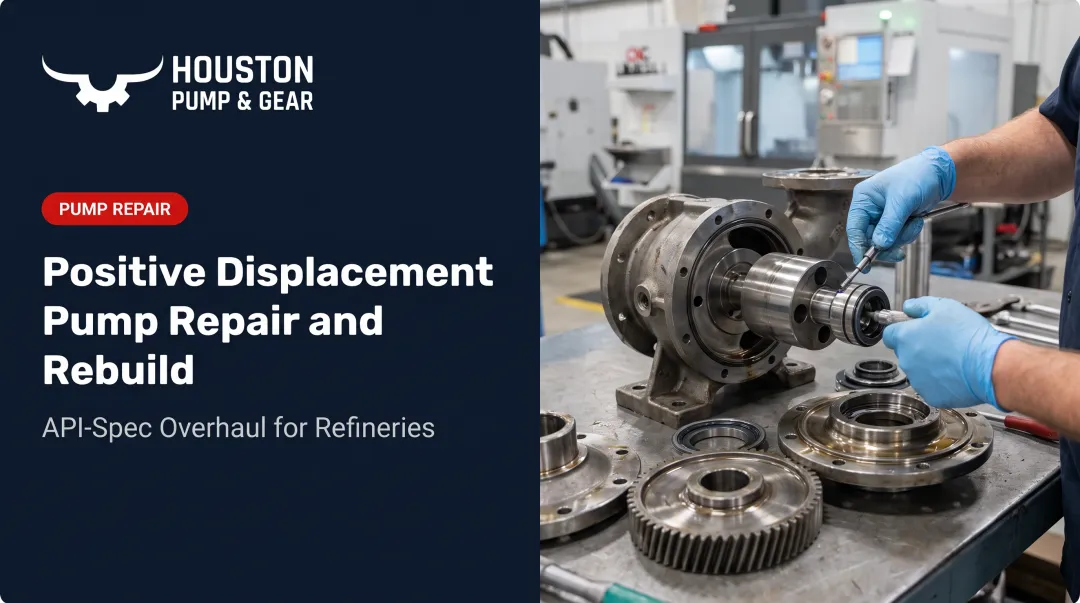
- Mechanical wear: Replace vanes, seals, gaskets, and bearings. Inspect rotor and stator surfaces for scoring before reassembly. A badly scored shaft in the seal area typically means the rotor needs replacing, not just resealing.
- Lubrication issues: Drain contaminated oil, clean oil passages, refill with correct viscosity and type.
- Environmental/operational issues: Correct ventilation, load conditions, or usage patterns causing recurring stress.
Rebuild with clean, correctly specified parts, repaired or replaced as needed. Realignment is often needed at this stage and should be scheduled into the downtime window, not treated as an afterthought.
Step 4: Test and Validate the Repair
Run the pump under normal and peak load. Monitor vibration, noise, and pressure/vacuum output against your baseline benchmarks. Watch for recurrence over a defined run-in period before returning the pump to full production.

When Should You Fix vs. Replace a Rotary Pump?
The decision comes down to repair cost, downtime risk, and how much service life is left in the unit.
| Situation | Fix | Replace |
|---|---|---|
| Wear items only (vanes, seals, gaskets) | Cost-effective rebuild restores near-original performance | Only if pump is obsolete or parts are unavailable |
| Pump under 10 years, isolated issue | Targeted repair extends useful service life | Rarely warranted unless damage is extensive |
| Severe scoring or major housing damage | Possible if parts are available and cost-justified | Usually more practical long-term |
| Critical, high-downtime-cost applications | Viable with rapid-response repair partners offering same-day pickup | Considered if repair timeline exceeds acceptable downtime |
When components are obsolete or hard to source, reverse engineering can recreate the part even if original drawings or OEM parts no longer exist. That option often makes repair viable on pumps that would otherwise be scrapped.
Power plants and other critical, high-downtime-cost applications change the calculation. Houston Pump & Gear's 24/7 emergency service across Texas and Louisiana is built for facilities that can't tolerate a multi-week wait for a replacement unit.

Common Mistakes and Preventive Measures
Mistakes that lead to repeat failures:
- Treating symptoms instead of the root cause
- Skipping post-repair testing and validation
- Using incompatible or non-spec parts
- Ignoring lockout/tagout safety procedures during teardown
Preventive measures that actually work:
- Schedule regular inspections and oil analysis
- Follow OEM maintenance intervals, not a generic calendar
- Maintain proper operating conditions (correct fluid, temperature, load)
- Document technician training and repair history for each unit
Pump failures always have a traceable root cause. Investigating that cause, instead of just patching the symptom, is what separates a lasting repair from one that fails again in six months. Consistent preventive maintenance reduces emergency shutdowns. When something does go wrong at 2 a.m., a documented repair history and a reliable service partner make recovery faster.
Conclusion
Most rotary pump issues are fixable when caught early and diagnosed correctly. The pumps that end up scrapped unnecessarily are usually the ones where someone guessed at the fix instead of confirming the root cause first.
Accurate diagnosis prevents repeat failures and wasted repair costs. Knowing when to fix versus replace protects your uptime and your budget. For facilities that can't afford extended downtime, partners like Houston Pump & Gear provide 24/7 emergency response. A pump failure at a power plant doesn't wait for business hours.
Frequently Asked Questions
Can a rotary pump be repaired?
Most issues involving vanes, seals, bearings, and gaskets are repairable through standard rebuild procedures. Severe housing damage or a badly scored rotor shaft may warrant replacement instead.
What are common types of rotary pumps?
Rotary vane pumps use sliding vanes in a cam-shaped housing to sweep fluid through the casing. Rotary gear/lobe pumps use meshing gears or lobes to trap and carry fluid to the outlet.
How long do rotary pumps typically last before needing a rebuild?
Service life depends on duty cycle, fluid type, and maintenance quality. Facilities that follow an 8-hour inspection and 250-hour full-service schedule typically run much longer than shops that wait for failure.
How much does rotary pump repair typically cost compared to replacement?
Repair costs vary by damage severity but are generally lower than full replacement, unless major components like the casing or rotor are destroyed beyond restoration.
How quickly can an emergency rotary pump or gearbox repair be completed?
Houston Pump & Gear offers 24/7 emergency response for industrial pumps and gearboxes, including a demonstrated 72-hour turnaround on a complex Lufkin S2212C gearbox.
What maintenance prevents most rotary pump failures?
Regular oil checks, seal and bearing inspections, and adherence to OEM-scheduled service intervals catch wear items before they cause secondary damage or unplanned downtime.