
Shaft problems build up over time. Misalignment, fatigue, corrosion, and normal wear all take a toll, especially on equipment that runs continuously in power plants and heavy industrial settings. This guide walks through the most common shaft failures, a step-by-step repair process, when to repair versus replace, and when the situation calls for an emergency repair specialist.
Key Takeaways
- Misalignment, fatigue cracking, corrosion/pitting, and journal wear cause most pump motor shaft failures
- Straightening, resleeving, and remachining often restore shafts without full replacement
- Confirm the root cause first, apply the right fix, then load-test before return to service
- Critical equipment downtime usually calls for 24/7 professional response, not wait-and-see
What Is a Pump Motor Shaft?
A pump motor shaft is the rotating component connecting the motor's rotor to the pump's impeller, typically through a coupling. It transmits torque and rotational energy while carrying the radial and axial loads generated during operation.
Beyond simple power transfer, the shaft has a second job: keeping everything centered. It maintains precise alignment between the driver and driven equipment, and it positions the impeller so rotor-to-casing clearances stay tight enough to limit flow losses and leakage.
The shaft is a wearing part inside a working system, not a set-it-and-forget-it component. It degrades under:
- Cyclic mechanical stress from constant load fluctuation
- Environmental exposure, including corrosive or abrasive fluids
- Operating conditions outside the original design envelope
That's why periodic inspection matters as much as the repair itself.
Common Pump Motor Shaft Problems & Why They Happen
Most shaft failures follow patterns tied to mechanical stress, environment, or installation error. Catching the pattern early is what separates a routine repair from an unplanned shutdown.
Misalignment
- Symptoms: Excessive vibration, unusual noise, premature bearing or seal wear
- Likely cause: Improper installation, a weak or uneven base, or thermal growth you didn't account for during setup
Misalignment raises friction at bearing surfaces, which accelerates wear well beyond what the design calls for.
Fatigue Cracking or Breakage
- Symptoms: Fine surface cracks, sudden snapping under load, fracture lines near keyways
- Likely cause: Repeated stress cycles, overload conditions, or a keyway/spline design that concentrates stress
Unsteady hydraulic loading fluctuates the force on the impeller, and that fluctuation is a documented driver of shaft-fatigue failures, according to the Hydraulic Institute's pump FAQ resource.
Corrosion and Pitting
- Symptoms: Visible rust, reduced shaft diameter, pitting concentrated near seal areas
- Likely cause: Wrong material for the fluid or environment, chemical exposure, or a damaged protective coating
Pitting creates stress risers on the shaft surface. Those weak points often become the start of cracks under normal operating loads.
Wear at Seal and Bearing Journals
- Symptoms: Leaks, looseness, increased runout, localized heat buildup
- Likely cause: Insufficient lubrication, dirt ingress, or incorrect running clearances
Once journal surfaces lose dimension, seals leak and bearings lose their fit. Both failures feed more vibration and heat back into the shaft.
What Happens If You Ignore These Signs
Left unaddressed, these problems compound quickly:
- Lower pump efficiency and weaker output quality
- Higher safety and compliance risk from unexpected failure
- Costly unplanned downtime that spreads to adjacent equipment

How to Fix a Pump Motor Shaft (Step-by-Step)
Attempting a fix before you fully understand the problem wastes time and money, and it usually leads to repeat failures. Working through these four steps in order ensures the root cause gets isolated and the fix actually holds.
Step 1: Identify the Exact Problem
Start by gathering evidence, not assumptions:
- Note visible or audible symptoms: vibration, unusual noise, seal leaks, overheating at bearing journals
- Compare current performance against the pump's normal baseline output and pressure
- Check vibration alarms, temperature sensors, or other condition-monitoring indicators
- Document when the issue shows up: at startup, under full load, or only during extended runs
Step 2: Confirm the Root Cause Category
Next, narrow down whether the issue is mechanical (bending, cracking, wear) or installation-related (alignment, foundation, coupling).
- Rule out coupling wear, foundation settling, or piping strain before condemning the shaft itself
- Inspect bearing journals, keyways, and seal surfaces for scoring or fretting that points back to the shaft
- Confirm the true cause before committing to shaft replacement; skipping this step often means spending money without fixing anything
Step 3: Repair the Shaft Based on the Identified Problem
The fix depends entirely on what Step 2 uncovered:
- Bent, worn, or cracked shafts: Straightening, precision remachining, sleeving, or keyway/spline recutting to restore OEM tolerances. Spline repair usually needs CNC remachining or a sleeve insert, not field welding.
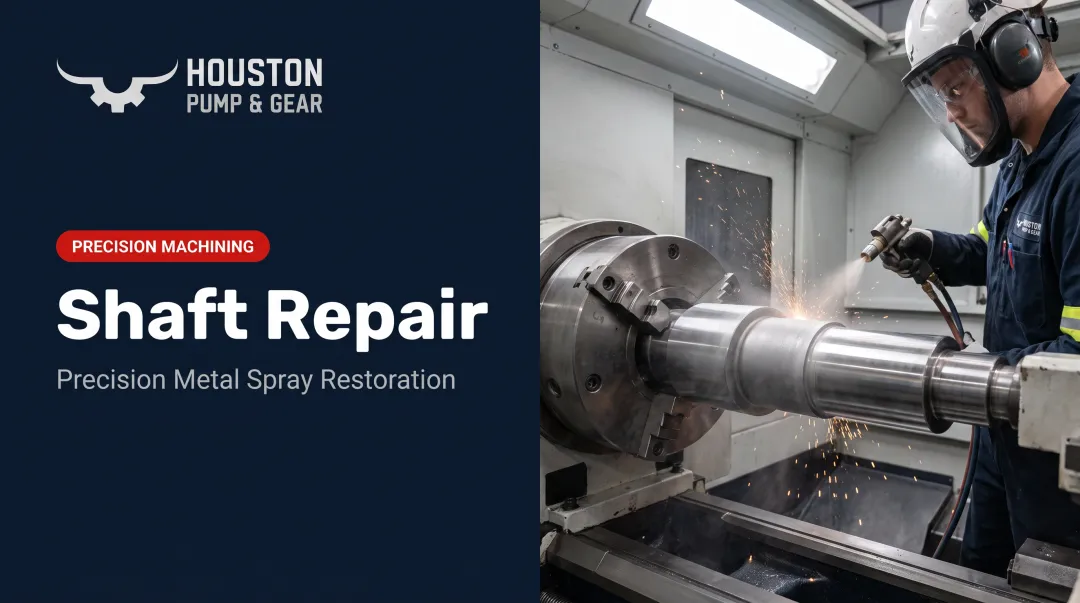
- Corrosion or surface wear: Resleeving, hard-facing, protective coating, or a corrosion-resistant material upgrade. Metal spray (including HVOF) can rebuild worn or pitted surfaces to required dimensions without scrapping the shaft.
- Alignment-related damage: Laser shaft alignment correction, foundation or base repair, and shim adjustment before reinstalling.
Before reassembly, verify shaft runout, dimensional tolerances, and surface finish against OEM specifications.
Precision remachining is often best handled by a shop with both machining capability and mobile field response. Houston Pump & Gear, for instance, services large gearbox and shaft assemblies for power plants and heavy industry clients across Texas and Louisiana.
Step 4: Test and Validate the Repair
A repair isn't finished when the shaft goes back in. Run the pump under normal and peak load, then:
- Monitor vibration, noise, and temperature at bearings and seals
- Confirm shaft runout and alignment fall within tolerance
- Watch for symptom recurrence over a defined monitoring period before calling the job done

When Should You Fix vs Replace a Pump Motor Shaft?
The fix-versus-replace call comes down to cost, safety, and how much life is left in the shaft.
| Condition | Fix | Replace |
|---|---|---|
| Minor wear or slight misalignment | Remachine journals and realign; geometry is still within safe tolerance | Not typically necessary at this stage |
| Fatigue cracking detected | Only viable if cracks are surface-level and non-propagating on non-critical equipment | Recommended once cracking is confirmed on load-bearing sections |
| Severe corrosion or pitting | Possible via resleeving if diameter loss is minor and localized | Necessary once diameter loss exceeds design tolerance |
| Critical equipment needing immediate return to service | Rapid-turnaround repair may be the only realistic path | Only viable if a replacement is already in stock |
Runout is often the deciding number. A 2022 industry guideline recommends replacing a shaft once runout exceeds 0.0025 to 0.003 inch. Check that range against your OEM and application tolerances rather than treating it as a universal rule.
When downtime cost is the real deciding factor: a 2023 ABB survey of over 3,000 plant-maintenance decision-makers found a median typical outage cost near $125,000 per hour across industrial sectors.
At that rate, a rapid, well-executed repair frequently beats waiting on a replacement shaft's lead time, even if replacement would technically be the cleaner fix.
That same downtime math drove Houston Pump & Gear's response when a Lufkin S2212C gearbox failure forced a power plant into emergency shutdown. A truck was dispatched the same day, the unit was collected and evaluated at the shop, and the plant was back online within 72 hours. Restoring critical operations that quickly kept a longer shutdown from snowballing into a bigger loss.
Common Mistakes to Avoid & How to Prevent Future Issues
A few recurring mistakes turn a manageable repair into a repeat failure:
- Treating symptoms, not causes: replacing bearings repeatedly without fixing the misalignment that drives the wear
- Skipping post-repair testing: undetected issues resurface under load once the pump is back in service
- Using incompatible materials or mismatched couplings: reintroduces stress concentrations the original design avoided
- Ignoring lockout/tagout: never optional during shaft removal and reinstallation
Preventive Measures That Extend Shaft Life
- Schedule regular vibration and alignment inspections rather than waiting for a failure
- Run condition-based health checks every 2-3 years under favorable conditions, and more often under harsh duty
- Keep operating conditions within design limits, including clean, non-corrosive fluid
- Train staff to spot early warning signs and keep maintenance documentation current

Frequently Asked Questions
How do you repair a damaged pump shaft?
Repair depends on the damage type: straightening for bent shafts, remachining or resleeving for worn or corroded sections, and precision recutting for damaged keyways or splines. Every repair should end with load testing before the pump returns to service.
How do you repair splines on a pump shaft?
Damaged splines are typically restored through precision CNC remachining or spline insert/sleeve replacement, with full shaft replacement reserved for wear beyond tolerance. Splines are critical to torque transfer, so field welding is rarely an acceptable fix.
What is a pump shaft?
A pump shaft is the rotating component that transmits torque from the motor to the impeller, enabling the pump to move fluid. It also supports radial and axial loads while keeping the rotor centered in the casing.
Can a bent pump motor shaft be straightened?
Minor bends can often be straightened using hydraulic presses and verified with runout checks afterward. Severe or repeated bending usually points to material fatigue that makes replacement the safer long-term choice.
How much does pump motor shaft repair typically cost?
Costs vary widely based on shaft size, material, and damage extent. Repair is generally more cost-effective than full replacement when the shaft's dimensions still fall within safe tolerance.
How long does pump motor shaft repair take?
Turnaround depends on damage severity and shop workload. Emergency shops with 24/7 capability can move fast on critical shaft jobs. Houston Pump & Gear has returned industrial equipment to full operation within 72 hours to limit power plant downtime.