
Industrial gearboxes inside power plants, refineries, and heavy manufacturing lines depend on precisely cut gear teeth and spline profiles to transmit torque without slipping, chattering, or seizing. A tooth-thickness error measured in thousandths of an inch can turn into vibration, premature bearing wear, or a full unplanned shutdown.
This guide covers what a gear spline actually is, how the major gear cutting and spline cutting methods work, and how a repair shop decides between re-cutting worn components and replacing them outright. That decision determines how fast a plant gets back online.
Key Takeaways
- A spline is a shaft-hub connection, not a gear-to-gear mesh—it centers parts while transmitting torque
- Hobbing, broaching, milling, and shaping cover most gear work; method choice depends on volume and geometry
- Internal splines are usually broached or shaped; external splines are usually hobbed or milled
- Worn gear teeth and splines can often be re-cut and salvaged if enough sound base material remains
- Fast re-machining cuts downtime—e.g., a 72-hour emergency Lufkin gearbox repair at a Texas power plant
What Is a Gear Spline, and How Does Gear Cutting Differ From Spline Cutting?
Gear cutting removes material from a round blank with a rotating cutter, broach, or shaping tool to form precise, evenly spaced teeth. That sets it apart from casting or forging, where teeth take shape by pouring or pressing material into a mold.
A gear spline is a multi-tooth ridge-and-groove connection machined into a shaft or a bore. It transmits torque between two components while also centering and locating them relative to each other. You'll find splines on coupling hubs, drive shafts, and gearbox output shafts throughout industrial equipment.
Spline cutting draws on the same family of methods (hobbing, shaping, and broaching), but the intent differs. Gear teeth are cut to mesh with a mating gear across separate axes. Spline teeth are cut for a precise axial fit between one shaft and one hub, with tighter control on fit class and centering accuracy.
Key Differences Between a Gear and a Spline
Both rely on cut teeth, but they serve different functions:
- A gear meshes with a second gear to transfer motion between two separate rotating axes, often changing speed, torque, or direction in the process.
- A spline connects a shaft to a hub along one shared axis. It transmits torque without changing speed or direction. It's a connection, not a transmission.
Common Spline Profiles Found in Industrial Gearboxes
Three spline profiles show up most often in industrial gearbox repair work:
- Straight-sided (parallel-sided) splines handle medium loads and appear on general-purpose shaft connections.
- Involute splines self-center under load, making them the standard choice for high-torque drivetrains and heavy industrial gearboxes.
- Serration or fine-tooth splines use thinner, closer-pitched teeth suited to light-duty connections or thin-wall hubs, where a coarser profile would remove too much material.
In a power plant gearbox running under constant load, tooth thickness and centering accuracy matter more than almost anything else in the design. Even a small fit inconsistency between shaft and hub creates vibration, and vibration accelerates wear on everything downstream: bearings, seals, and the gear teeth themselves.
Gear Cutting Methods: How the Different Approaches Work
Four processes account for most industrial gear cutting: hobbing, broaching, milling, and shaping. Shops choose among them based on gear size, production volume, and whether the teeth sit inside a bore or on the outside of a shaft.
- Hobbing: A rotating hob and gear blank mesh as the hob feeds across the face, generating the tooth profile continuously. Standard for medium-to-high volume spur, helical, and worm gears, but limited to external teeth.
- Broaching: A progressively toothed tool is pulled or pushed through the blank in one stroke. Excels at internal teeth and large gears in high-volume runs; dedicated tooling makes it costly for one-off repairs.
- Milling: An indexed cutter matched to the tooth count cuts one space at a time. Most flexible for prototypes, small batches, and non-standard forms that don't justify hob or broach tooling.
- Shaping: A pinion-shaped cutter reciprocates while cutter and blank rotate on parallel axes. Handles internal and external gears at any volume and is one of the few methods suited to internal spline cutting.

After the initial cut, finishing—shaving, grinding, honing, or lapping—corrects heat-treatment distortion and holds tight tolerances on high-load gears.
The right choice usually comes down to three questions: how many teeth need cutting, whether they're internal or external, and how many units are needed—one prototype or ten thousand identical parts.
How Are Splines Cut? Spline Cutting Methods in Practice
Cutting a spline uses the same core processes as gear cutting, but the right method depends on whether the spline sits inside a bore or on the outside of a shaft.
Cutting Internal Splines
Broaching handles the bulk of high-volume internal spline work. A single broach stroke can turn a pilot hole into a finished involute or straight-sided spline, making internal broaches the workhorse tool for spline bores and serration profiles.
Gear shaping is the more flexible alternative. It fits prototypes, small production runs, or bores with complex geometry where dedicated broach tooling isn't practical.
Cutting External Splines
Hobbing is the standard method for external splines and shaft-mounted spline profiles in volume production. It uses the same continuous-generation process applied to external gears.
Milling steps in for low-volume runs, custom shafts, or unique profiles that don't justify dedicated hob tooling. It's the more common choice in repair work, where each shaft may need a slightly different fix rather than an identical mass-produced part.
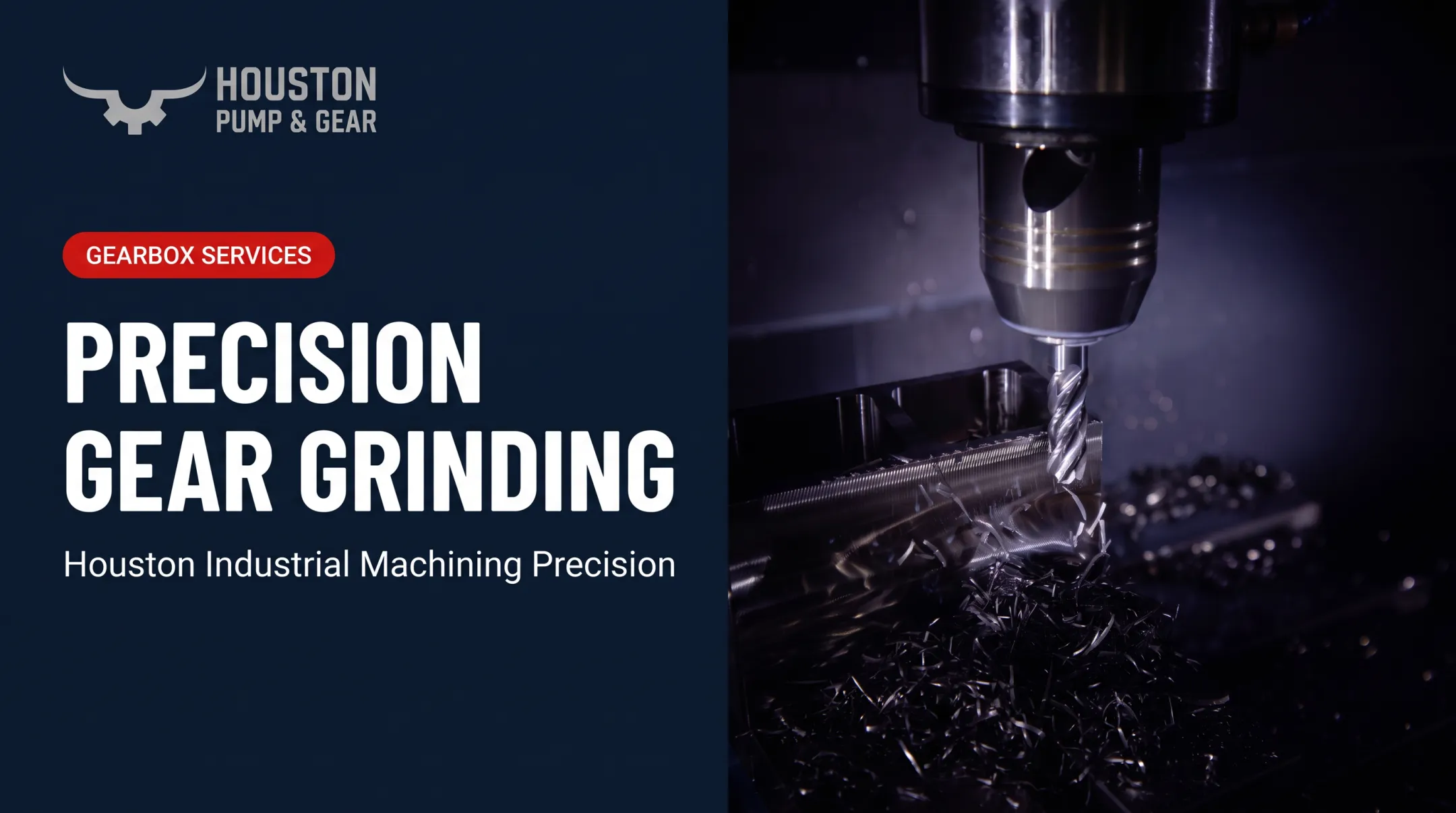
Houston Pump & Gear runs both processes in-house at its Houston facility. CNC gear hobbers rated up to 53 inches OD and four-axis CNC milling centers cover most external spline repair without sending parts to a second shop.
One detail matters more in repair work than in original manufacturing: heat treatment shifts tooth thickness. Hardening a shaft after cutting can distort the spline just enough to affect fit, so a finishing or correction pass often follows.
That step is critical when re-cutting a worn industrial shaft rather than machining new stock. The base material has already been through a full service life of thermal cycling.
Gear and Spline Wear: When Repair Requires Re-Cutting Instead of Full Replacement
A worn gear or spline rarely fails without warning. Watch for:
- Abnormal vibration during operation, especially compared to a baseline reading
- Play or looseness at the coupling that wasn't there when the unit was new
- Metal particulate turning up in routine oil sample analysis
- Unusual noise under load that wasn't present before
Any one of these can point to advancing wear on gear teeth or spline profiles inside the gearbox. Oil analysis showing metal particulate is often the earliest reliable signal, catching wear before it progresses to noise or measurable vibration.
Whether a technician re-cuts a worn component or recommends full replacement comes down to two factors: how much sound base material remains, and the condition of the metal under the worn surface.
- Re-cutting works when enough sound material remains to cut a clean new tooth profile, restoring the part at a fraction of replacement cost and lead time
- Replacement is safer when wear has eaten into the case-hardened layer, or the base metal shows cracking, pitting, or fatigue

Turnaround speed on that decision matters most in power generation, where a single idle gearbox can shut down an entire production line. Unplanned downtime costs industrial operators close to $125,000 per hour on average, according to ABB's 2023 survey of more than 3,200 plant maintenance decision-makers.
At that rate, a shop's ability to inspect, decide, and re-cut fast is the difference between a manageable repair bill and a seven-figure production loss.
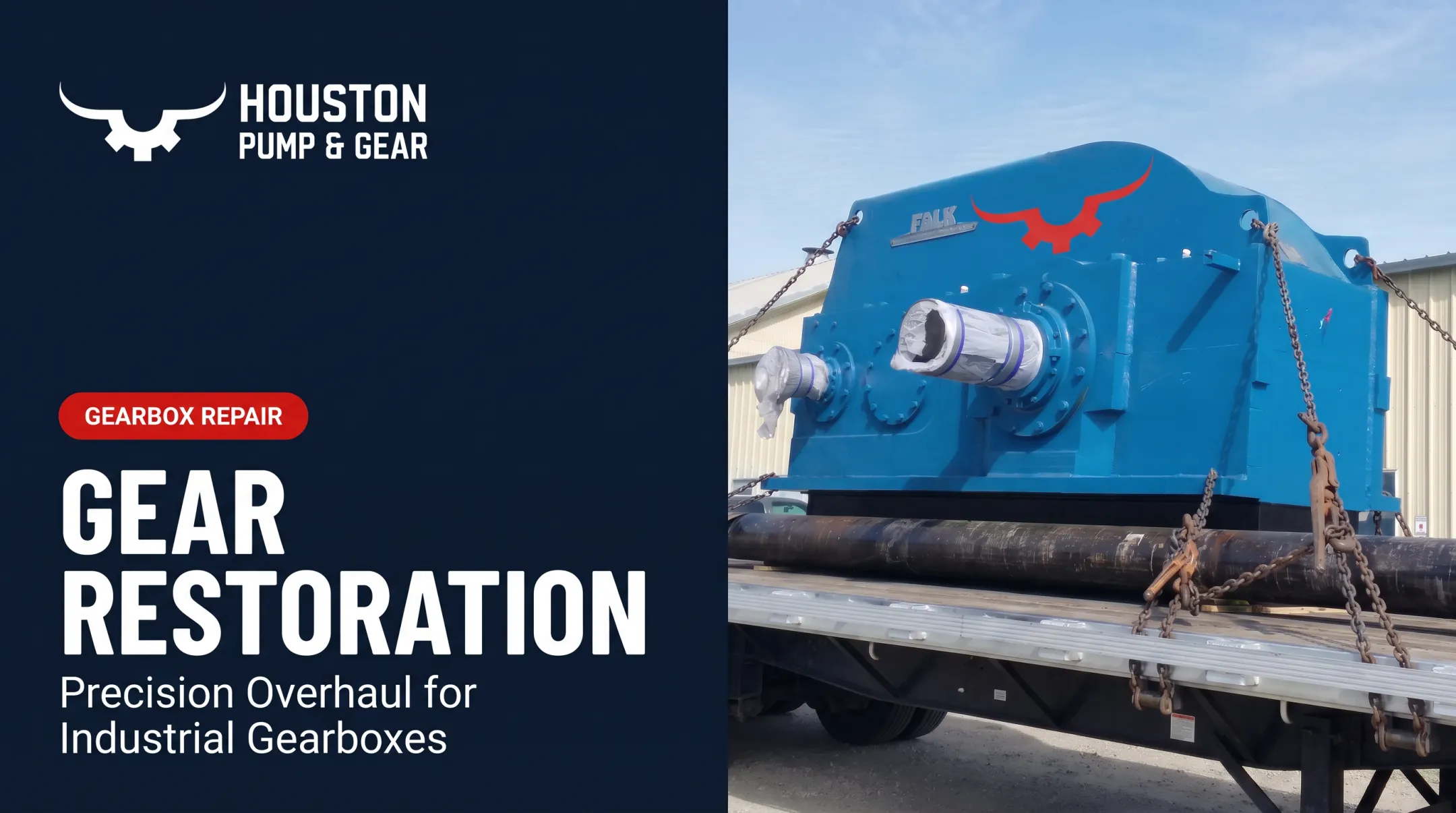
Houston Pump & Gear's own history shows what that looks like in practice. In 2014, a Texas power plant's Lufkin S2212C gearbox failed and forced a full emergency shutdown.
The operator called Houston Pump & Gear, which dispatched a truck the same day and brought the gearbox to its Houston shop. The plant was running again within 72 hours. That turnaround depended on inspecting and re-machining critical components in-house rather than waiting on outside vendors for each step.
Choosing a Gear and Spline Cutting Partner for Industrial Gearbox Repairs
When a gearbox is down, the last thing a plant needs is its repair shop shipping components to three different vendors for cutting, hobbing, and finishing. Look for a partner with as much of the process chain under one roof as possible:
- In-house hobbing, milling, and finishing/grinding: external gears and splines stay on-site through the full repair
- Broaching and shaping access: internal profiles and complex bore geometries without a second vendor
- 24/7 emergency availability: same-day mobile pickup and dedicated transport when failures hit off-schedule
- Documented heavy-industrial track record: complex gearbox work, not only standard off-the-shelf models
Houston Pump & Gear runs CNC gear hobbers rated up to 53 inches OD, four-axis CNC milling centers, and Niles and Gleason CNC form grinders rated to AGMA Q15. That lineup covers most gear and spline repair work at its Houston facility.
When a Lufkin S2212C failed at a Texas power plant, the company dispatched a truck the same day—part of its around-the-clock response. That relationship started when project manager Vince Parker met the plant's operator at an industrial convention and has grown to more than 15 units serviced for that client alone.

For power plants and heavy industry across Texas and Louisiana dealing with a failing gearbox, Houston Pump & Gear is available 24/7 at +1 832-603-9663.
Frequently Asked Questions
What are the different methods of gear cutting?
The four core methods are hobbing, broaching, milling, and shaping. Each is chosen based on gear size, production volume, and whether the teeth are cut internally or externally.
How are splines cut?
Internal splines are typically broached or shaped, while external splines are typically hobbed or milled. The choice depends on production volume, spline location, and precision requirements.
What is a gear spline?
A gear spline is a multi-tooth shaft-hub connection that transmits torque while centering and locating mating components. Unlike a gear, it doesn't mesh with another gear; it connects two parts along one shared axis.
What's the difference between a gear and a spline?
A gear meshes with another gear to transfer motion between two separate rotating axes, often changing speed or direction. A spline connects a shaft and hub along a single axis, transmitting torque without changing speed or direction.
Can worn splines be repaired instead of fully replaced?
Often, yes. If enough base material remains and the core metal is sound, a worn spline can be re-cut to restore its profile. Severe wear or damage to the shaft or hub core typically requires full replacement.
How long does an emergency gear or spline repair typically take?
Turnaround depends on gearbox size and damage severity. Houston Pump & Gear's 72-hour emergency turnaround on a Lufkin S2212C gearbox is a useful benchmark for critical industrial repairs.