
Unplanned gearbox downtime can shut down an entire production line, and new replacement equipment can take months, sometimes over a year, to arrive. That's why understanding precision gear grinding matters, not just for machinists, but for anyone responsible for maintenance planning.
This article covers what precision gear grinding actually is, how it differs from cutting, the main grinding methods used in industry, warning signs your gearbox needs attention, and why this process matters for long-term reliability.
Key Takeaways
- Precision gear grinding is a finishing step—not a cutting process—used after heat treatment to correct distortion and tighten tolerances
- Two grinding methods dominate the industry: form (profile) grinding for accuracy, generating grinding for volume
- Whining, grinding noise, or vibration in a gearbox usually signals worn or misaligned teeth
- Emergency gearbox failures at power plants demand rapid-response repair partners to limit downtime costs
What Is Precision Gear Grinding?
Precision gear grinding is an abrasive finishing process. After a gear's teeth are cut, an abrasive wheel spinning at high speed removes microscopic amounts of material. That pass corrects surface irregularities and hits exact dimensional tolerances.
Think of it like carving versus polishing. Cutting shapes the gear; grinding refines what's already there. It doesn't change the fundamental geometry. It perfects it.
Why the precision grade matters:
- Under ANSI/AGMA 2015 standards, gears are graded on accuracy scales from A2 (highest precision) to A11 (lowest), based on measurements like pitch, lead, and profile form
- Post-heat-treatment grinding on large industrial gears has achieved surface roughness as fine as Ra 0.3 micrometers, according to Mitsubishi Heavy Industries' technical research
- That level of finish isn't achievable through cutting alone

Why Heat-Treated Gears Need Grinding
Heat treatment hardens gear teeth for durability, but the process introduces residual, thermal, and transformation stresses that warp tooth geometry. Uneven cooling during quenching is a major culprit. Grinding corrects that distortion after the fact. Without it, you're left with a hardened gear that no longer fits its intended profile.
Why Precision Matters in Industrial Applications
Small tooth deviations aren't cosmetic. Under heavy industrial loads, they create transmission error — one of the leading causes of gear noise and vibration. Severe misalignment limits contact area between teeth and accelerates pitting.
This is especially critical in high-torque equipment like power plant turbines and heavy industrial gearboxes, including Lufkin models used across power generation, oil and gas, and marine applications. When these units run continuously, even minor geometry errors compound fast.
Gear Cutting vs. Gear Grinding
These two processes work together, but they're not interchangeable.
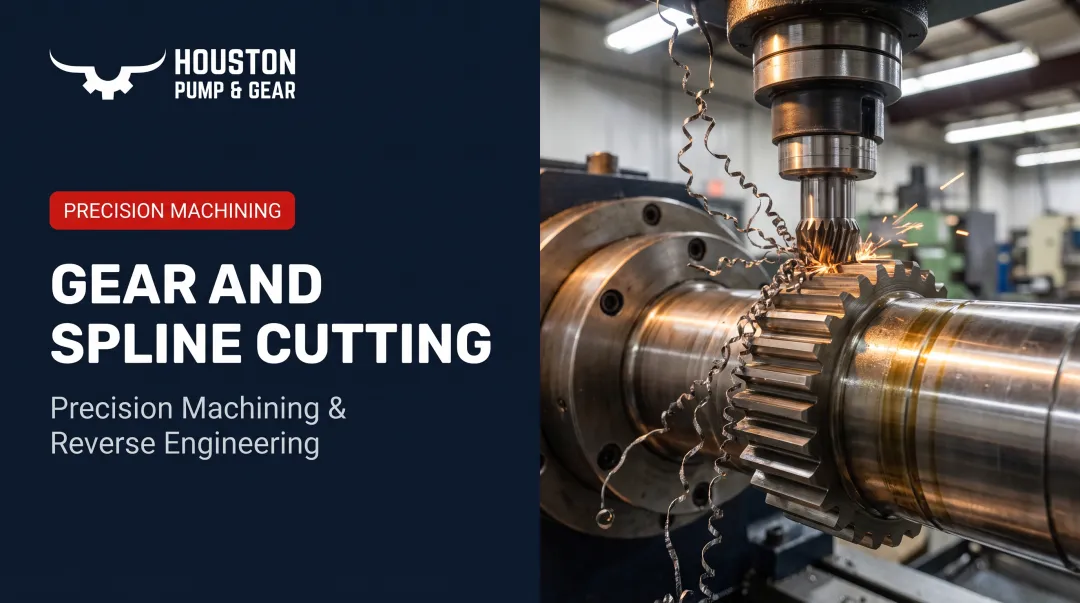
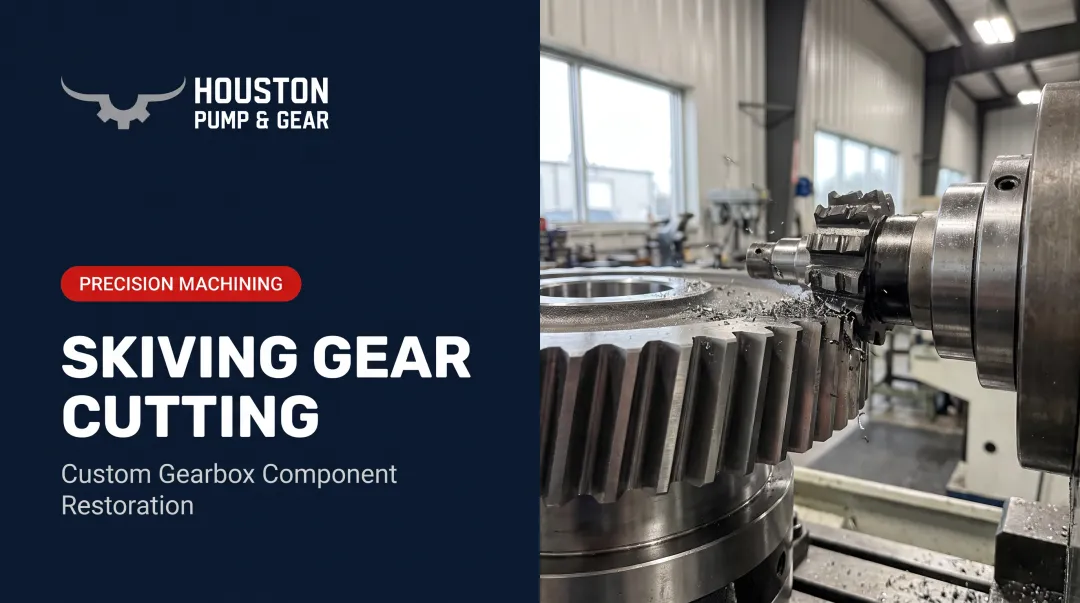
Gear cutting (hobbing, shaping, milling, broaching) shapes the basic tooth geometry from a raw blank:
- Hobbing — continuously rotating tools cut teeth, best for medium-to-large production runs
- Shaping — rack or pinion cutters generate the profile, suited to smaller batches
- Milling — shapes teeth individually, good for custom, low-volume gears
- Broaching — fast, cost-efficient for mass production of large gears, but expensive for custom work
Gear grinding happens after cutting and heat treatment. Hardening distorts tooth geometry; grinding corrects that shift and brings the gear to final tolerance.
Grinding typically delivers:
- Corrected profile, lead, and pitch after heat treat
- Smooth surface finish that lowers noise and wear
- Tight tolerances for high-speed and high-load applications
| Factor | Gear Cutting | Gear Grinding |
|---|---|---|
| Purpose | Forms initial tooth shape | Refines and corrects final geometry |
| Precision | Moderate | High (tight tolerances) |
| Surface finish | Rougher | Smooth, polished |
| Speed/cost | Faster, lower cost | Slower, higher cost per part |

Cutting gets you close. Grinding gets you exact.
Types of Gear Grinding Methods
Two grinding approaches dominate industrial practice, and the right choice depends on production volume and required accuracy.
Form (Profile) Grinding
A wheel is dressed with the exact profile of the tooth space, then grinds each tooth individually. This method delivers very high accuracy but works best for lower-volume, high-precision jobs, like custom or legacy gearbox components.
Generating Grinding
The grinding wheel and the gear rotate in synchronized motion, with the wheel dressed to a gear-rack form. The profile is generated through motion rather than a fixed shape. This method is faster and better suited to larger production runs.
A final polishing pass typically follows either method, removing remaining imperfections for a smooth, bright tooth surface.

A few practical notes apply to both methods:
- Wheel selection: Abrasive type, grit, and bond affect surface finish and grinding temperature. The wrong setup can cause grinding burn, weaken the tooth surface, and cut fatigue life.
- Rebuild re-grinding: Common on industrial and power plant gearboxes, and often far more cost-effective than full remanufacture.
- Cost vs. new: Gearbox overhauls can save 40-50% compared with buying new.
Signs Your Industrial Gearbox Needs Grinding or Repair
Gearboxes tend to announce problems before they fail outright. Catching these signs early is the difference between a scheduled repair and an emergency shutdown.
Watch for:
- Grinding noises, whining, or vibration during operation — often the earliest indicator of worn or damaged teeth
- Visible pitting, chipped teeth, or metal shavings in gearbox fluid — a sign teeth are no longer meshing precisely
- Inconsistent load handling or overheating — frequently points to tooth misalignment
- Progressive micropitting on tooth surfaces — leaves large areas porous and cracked over time, per Machinery Lubrication's gear wear research
The cost of ignoring these signs escalates fast. A gearbox failure on a deep-sea oil rig can cost companies around $1.5 million per day in lost production.
On land, catastrophic industrial gearbox failures can run $10,000 to over $100,000 in repair costs alone, with full replacement or rebuild reaching up to $150,000 in extreme cases.

Why Precision Gear Grinding Matters for Industrial Reliability
Precision-ground gears reduce friction, noise, and heat. That translates directly into longer service life for gearboxes running continuous duty in industrial and power generation settings.
Downtime in power generation carries outsized financial consequences. A single day offline can mean lost output, missed contracts, and emergency labor costs stacked on top of the repair itself. That's why precision grinding as preventive maintenance isn't optional for facilities running critical equipment.
Not every facility has in-house grinding capability. That makes a trusted external repair partner essential, both for scheduled maintenance and for emergencies that can't wait.
Houston Pump & Gear serves as a 24/7 emergency and long-term gearbox repair partner for power plants and heavy industry across Texas and Louisiana. When a Lufkin S2212C gearbox went down during an unplanned power plant shutdown, our team sent a truck the same day, picked up the unit, and had the plant back online 72 hours later.
That kind of turnaround depends on:
- Mobile field response with dedicated transport trucks for immediate equipment pickup
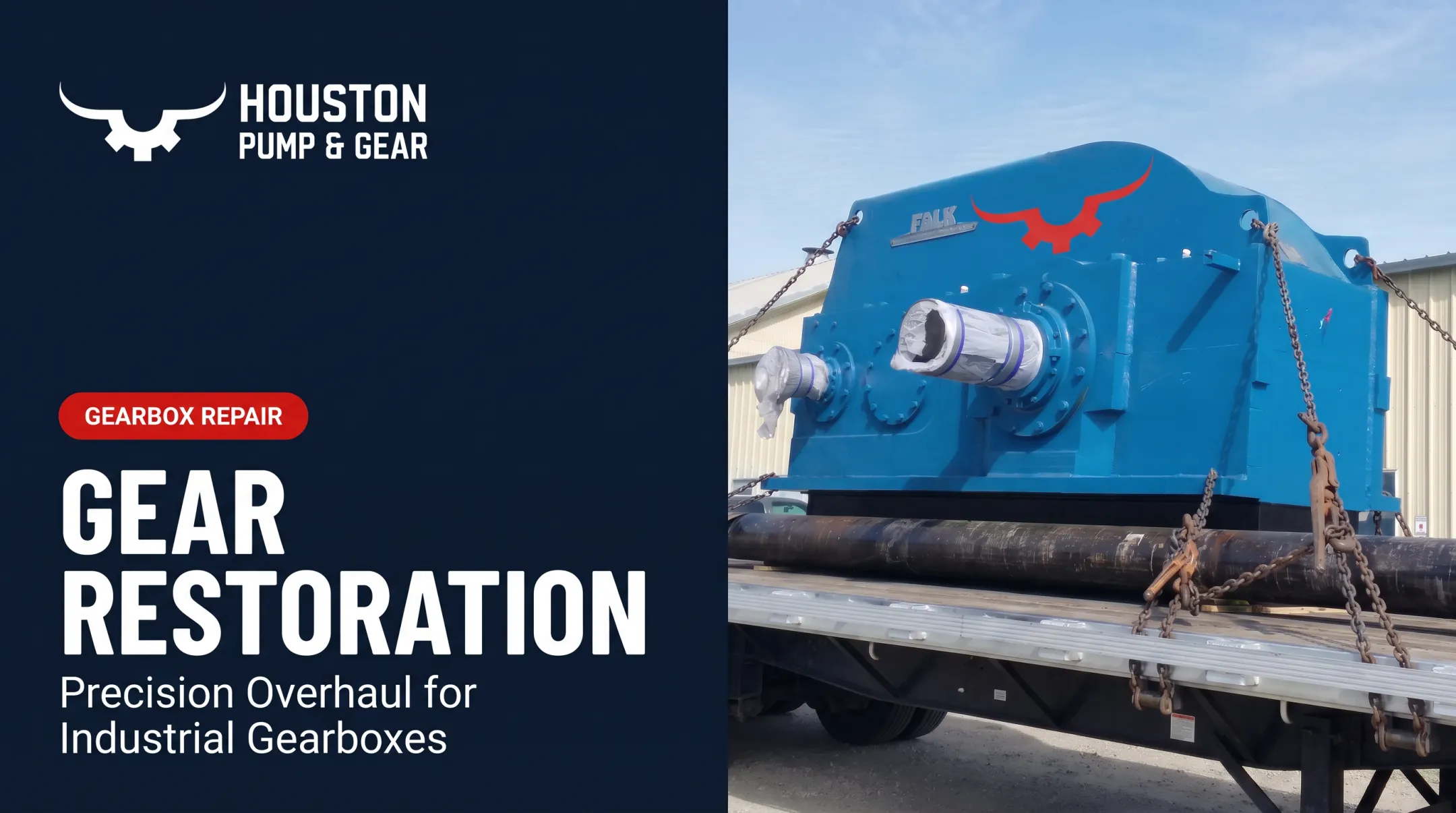
- Experienced technicians familiar with complex models across major brands (Falk, Flender, Lufkin, Philadelphia Gear, and others)
- Nationwide logistics support to move equipment to our Houston facility quickly
When an emergency shutdown hits, a partner who can respond the same day—not next week—is what protects uptime and keeps critical equipment online.
Frequently Asked Questions
What is the difference between gear grinding and shaving?
Shaving removes material with a cutting tool before hardening, refining the tooth shape while it's still soft. Grinding is an abrasive process typically performed after heat treatment, correcting distortion for tighter final tolerances.
When do gears need grinding?
Gears typically need grinding after heat treatment distorts tooth geometry, when inspection shows profile or lead errors beyond tolerance, or when the duty cycle demands a finer finish and tighter accuracy than cutting alone can deliver.
What does gear grinding mean?
Gear grinding is the abrasive finishing process that brings gear teeth to precise dimensional tolerances and a smooth surface finish, usually after the teeth are cut and heat-treated.
Which machines are used for gear cutting?
Common gear-cutting equipment includes hobbing machines, gear shapers, milling machines, and broaching machines. Each suits different volumes and gear types; many cut gears are later ground after heat treatment for final tolerances.
What is a gear grinder?
A gear grinder is a specialized machine using abrasive wheels or grinding worms to finish gear teeth to exact tolerances after cutting. It corrects distortion from heat treatment and achieves the final surface finish.