
Seal wear happens gradually. Chemical exposure, dry running, misalignment, and skipped maintenance intervals all take a toll over time. This guide walks through the most common shaft seal problems, a step-by-step repair process, when to repair versus replace, and when it makes sense to call in a partner like Houston Pump & Gear.
TL;DR
- Leaking seal plates, scored faces, and failure within months are the usual shaft-seal problems
- Repair vs. replace depends on shaft, housing, and bearing condition—not the seal alone
- Diagnose symptoms, confirm root cause, repair, then test under load
- Call a specialist for large industrial pumps, emergency shutdowns, or unsupported legacy equipment
What Is a Water Pump Shaft Seal?
A water pump shaft seal is a mechanical seal: two mating faces, one rotating with the shaft and one stationary in the housing. The faces spin against each other without making solid contact.
Three forces keep the seal closed while the shaft turns:
- A thin fluid film between the faces
- Spring tension holding the faces together
- Hydraulic pressure from the pumped fluid
The face gap is measured in microns—tight enough to block contaminants, thin enough for free rotation. As a wear component, it needs periodic inspection and eventual replacement to keep the pump reliable.

Common Problems With Water Pump Shaft Seals
Shaft seal failures tend to follow predictable patterns. Catching the failure mode early saves parts and downtime.
Water Leaking From the Seal Area
Symptoms: A steady drip or wet streak where the seal plate meets the motor housing.
Likely causes:
- Worn seal faces
- Chemical degradation of the elastomers
- Scoring from a prior dry-run event
Some leaks are temporary settling leakage right after a new seal is installed. That is normal for the first few duty cycles.
Excessive Noise or Vibration Near the Seal
Symptoms: Grinding, squealing, or noticeable vibration during operation.
Likely causes:
- Misalignment
- Worn bearings
- Incorrect seal seating from the last install
Premature Seal Failure
Symptoms: Repeated leaks within months of a replacement.
Likely causes:
- Wrong seal type for the application
- Contamination during installation
- Improper fitting
- Thermal shock
This is one of the most frustrating failure modes because it often gets blamed on "a bad part" when the real issue is installation or selection.
Overheating at the Seal or Bearing Housing
Symptoms: A hot-to-touch housing, discoloration, or melted seal components.
Likely causes:
- Dry running
- Loss of prime
- Inadequate cooling flow to the seal faces

Why Water Pump Shaft Seals Fail
Seal failure rarely happens in isolation. It's usually the byproduct of how the pump is run, installed, and maintained:
- Operational stress from continuous high-RPM duty cycles
- Environmental exposure to corrosive fluids, high heat, or abrasive particulates
- Installation errors, such as touching seal faces or misaligning the shaft during assembly
- Skipped maintenance, where small issues go unnoticed until they escalate into failures
Ignoring early warning signs has real consequences. A study of 11,000 mechanical seal failures across 148 plant sites found that 13% traced back to inadequate bearing maintenance. Seal issues are often symptoms of a larger mechanical problem.
Left unaddressed, seal failure leads to:
- Reduced pumping efficiency and flow output
- Water ingress damaging motor windings
- Safety or compliance risks in power plant settings
- Unplanned downtime costing thousands to millions per day, per Houston Pump & Gear field experience
The Hydraulic Institute notes that over a pumping system's 15-to-20-year life, maintenance accounts for roughly 25% of total cost. A few days of lost production can outweigh the entire cost of the pump system itself.
How to Fix a Water Pump Shaft Seal: Step-by-Step
Fixing a seal without properly diagnosing the failure wastes time and money. Skip the diagnosis, and you'll likely be back here in a few months.
Step 1: Identify the Exact Problem
Before touching anything, gather information:
- Where exactly is the leak located?
- Is there noise, vibration, or heat?
- Has flow or pressure dropped from baseline?
- Do plant monitoring systems show alarms?
- Does the issue happen at startup, under load, or continuously?
Step 2: Confirm the Root Cause Category
Determine whether the failure is mechanical (wear, misalignment), operational (dry running, cavitation), or installation-related. Rule out external factors like poor water quality or extreme ambient temperatures.
Don't replace the seal before confirming the cause. Skipping this step is how facilities end up buying the same part twice.
Step 3: Fix the Seal Based on the Diagnosis
Mechanical wear issue:
- Disassemble the pump and pull the old seal with the proper tool
- Clean the shaft and seal plate thoroughly
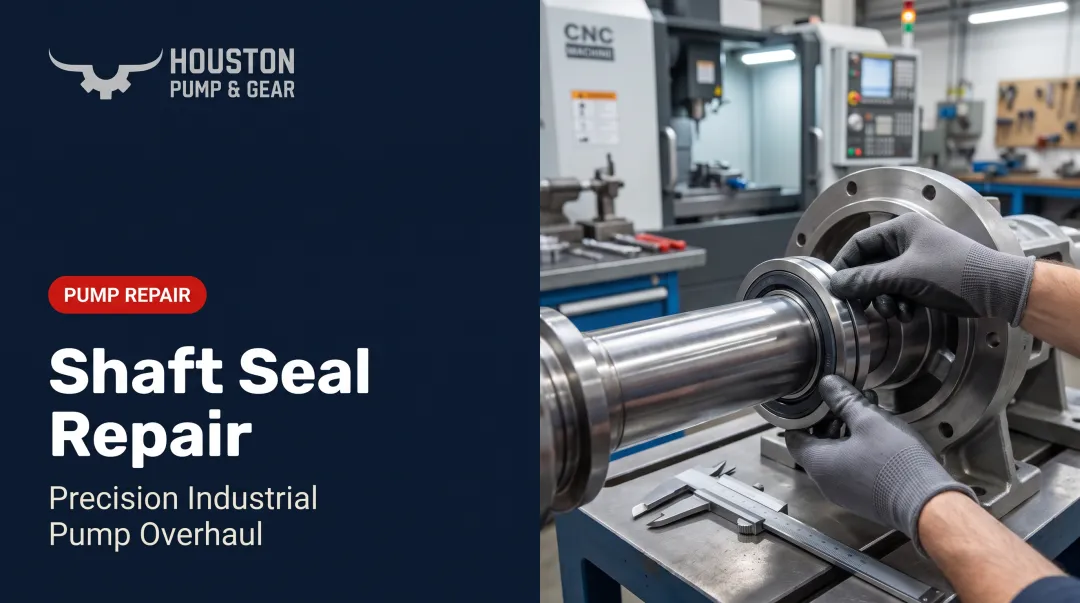
- Install new seal faces without touching the polished surfaces
- Check shaft alignment, O-ring condition, and proper seating before closing up
Misalignment or installation error:
- Look for uneven wear patterns or seal blow-out as telltale signs
- Realign the shaft and coupling
- Verify seal orientation and spring compression against OEM specs
- Use proper alignment tools going forward, not guesswork
Operational factors (dry running, cavitation):
- Restore proper priming and correct any suction issues
- Install low-flow protection to prevent recurrence
- Train operators on early warning signs and consider automated shutoff controls
Step 4: Test and Validate the Repair
Run the pump under normal and peak load conditions, then verify:
- No leaks at the seal face or gland
- Noise and vibration stay within baseline
- Flow and pressure match expected benchmarks over an extended run
For critical power plant equipment, professional validation matters. Houston Pump & Gear technicians run vibration and temperature checks at multiple points over a couple of hours of operation before signing off, catching issues before they become a second shutdown.

When Should You Fix vs. Replace the Shaft Seal?
Use this matrix to decide whether a seal repair will hold, or whether the pump needs a fuller overhaul or replacement.
| Scenario | Fix When | Replace When |
|---|---|---|
| Isolated wear on healthy pump | Shaft, bearings, and housing are in good shape | Repeated failures suggest deeper wear |
| Emergency shutdown | Rapid seal swap restores operation | Damage extends beyond the seal (such as motor windings) |
| Aging equipment | Unit is otherwise reliable, parts are available | Failures recur and downtime costs outweigh replacement |
| Legacy/custom pump models | An experienced shop can source or machine compatible parts | No viable repair path exists or OEM support has ended |
Houston Pump & Gear bases its recommendation on the actual condition of the seal, gasket, shaft sleeve, and housing. There is no blanket rule. When a standard part isn't available for an older model, reverse engineering is often a faster path than waiting on a replacement pump.

Common Mistakes to Avoid
- Treating the symptom, not the cause. A leak might be dry running, wear, or misalignment. Fix the wrong one and the leak comes back.
- Skipping post-repair testing. A seal that looks fine at idle can fail under real load.
- Using generic seal kits. Pump-specific parts matter—wrong dimensions or materials fail early under load.
- Touching seal faces with bare hands. Skin oils contaminate lapped faces and cause premature leak paths.
- Skipping lockout/tagout during disassembly. Always isolate energy sources before work begins.
Preventive Measures to Avoid Future Shaft Seal Issues
Prevention is cheaper than emergency repair, every time. A few habits go a long way:
- Schedule regular inspections of seal areas for early leak detection
- Follow manufacturer-recommended maintenance intervals and lubrication schedules
- Maintain proper priming, alignment, and fluid quality
- Train staff to recognize early warning signs
- Partner with a 24/7 emergency repair provider for complex industrial units
Houston Pump & Gear brings over two decades of industrial pump repair experience and 24/7 emergency service for facilities that need a trusted partner on call when seal issues escalate.
Conclusion
Most water pump shaft seal issues are fixable when caught and diagnosed early. Root-cause diagnosis matters more than chasing symptoms alone. A leak might mean a worn seal face, or it might mean the pump has been running dry for weeks.
Knowing when to fix versus replace, and having a rapid-response partner on call, saves both cost and downtime. Houston Pump & Gear offers free diagnosis and inspection, along with 24/7 emergency service across Texas and Louisiana, for facilities that can't afford to wait.
Frequently Asked Questions
What is the average cost to repair a water pump?
Costs vary based on pump size, seal type, and damage severity. Industrial seal repairs typically cost far less than a full pump replacement, especially when the issue is caught early.
What is a shaft on a pump?
The shaft is the rotating component that connects the motor to the impeller. The shaft seal's job is to protect this connection point from water leakage.
How do I know if my water pump shaft seal is failing?
Look for a leak at the seal plate/motor junction, along with unusual noise, vibration, or a housing that's hot to the touch. Any of these means it's time for inspection.
Can a water pump shaft seal be repaired without replacing the whole pump?
In most cases, yes. If the shaft and housing are undamaged, the seal alone can be replaced without touching the rest of the pump.
How long does a water pump shaft seal typically last?
Service life varies widely by application, but some OEM manuals specify replacement at 20,000 operating hours or two years, whichever comes first. Harsh operating conditions can shorten that window significantly.
When should I call a professional for shaft seal repair instead of DIY?
Call a professional for large industrial pumps, emergency shutdowns, or legacy equipment without available parts. Houston Pump & Gear's 24/7 emergency response team frequently completes repairs in days or hours when other shops quote weeks.