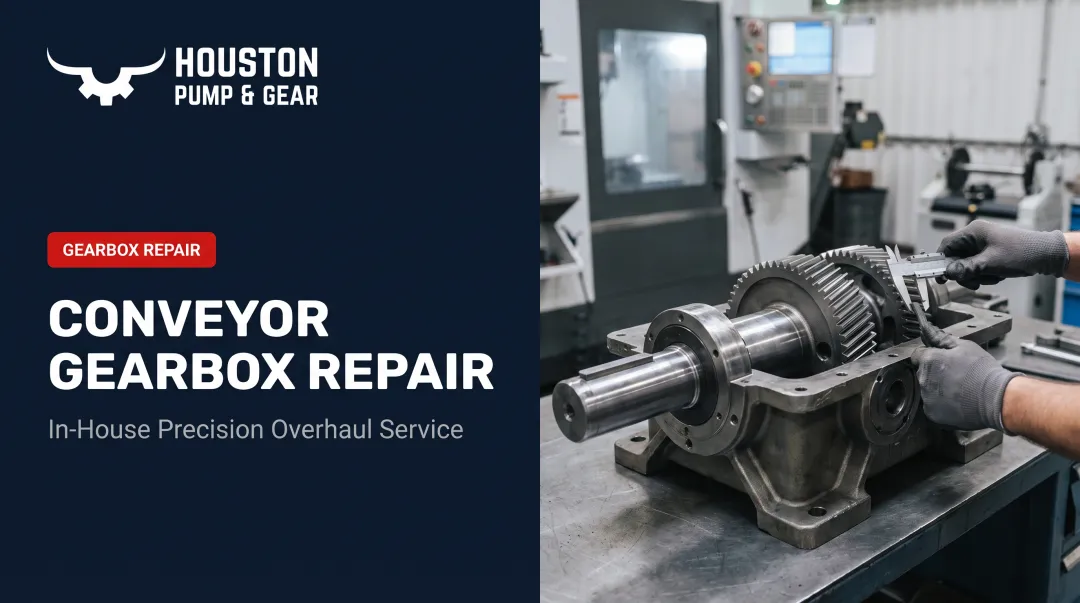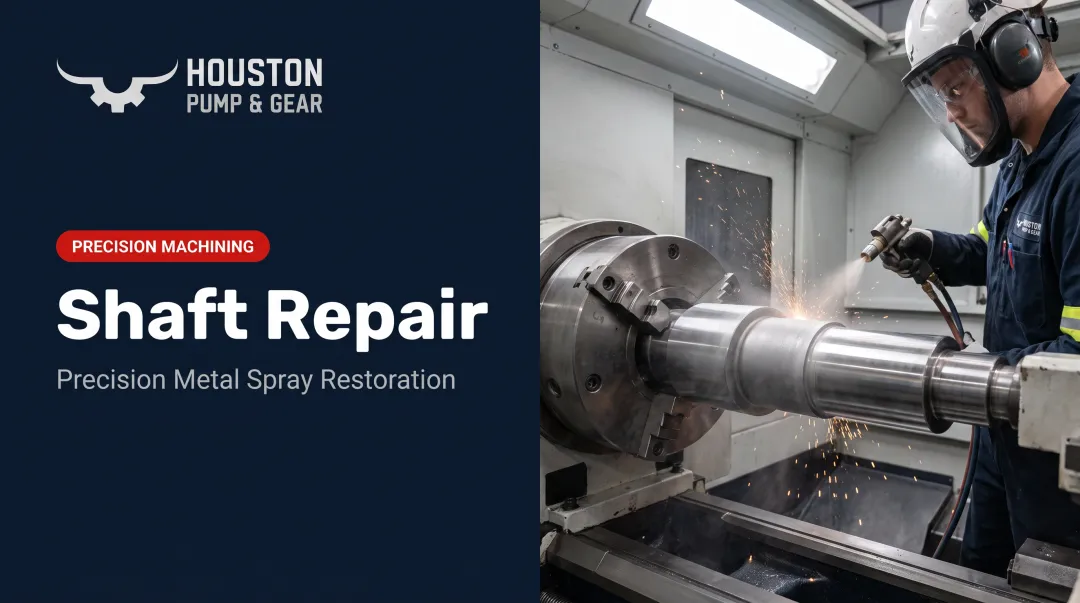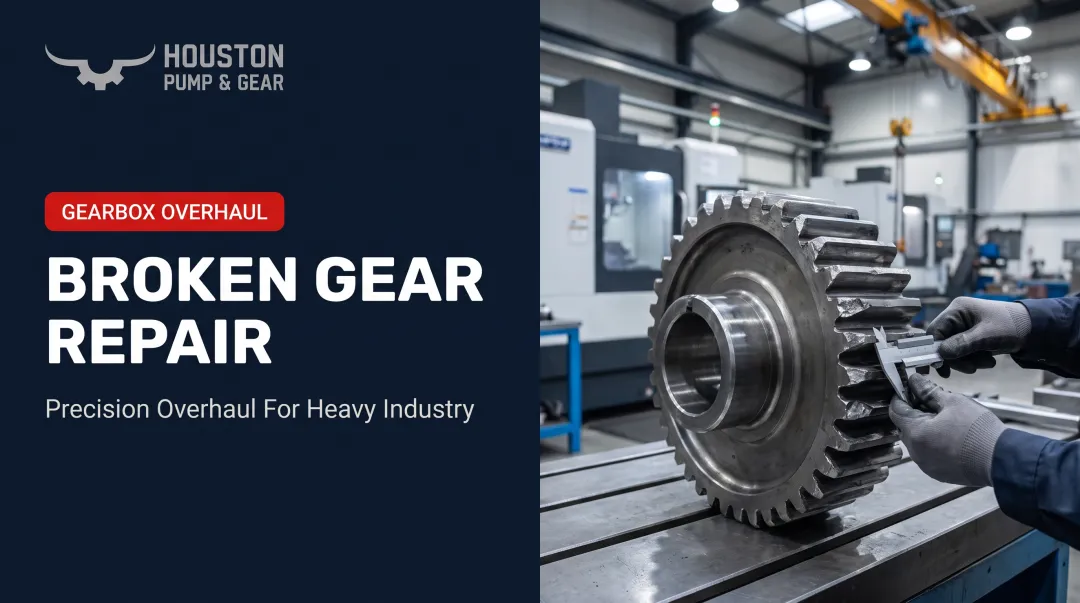

Wear, contamination, misalignment, and maintenance gaps inevitably cause problems in these systems over time. A gear tooth chips. A seal wears thin. A bearing runs dry. None of this happens overnight, but ignored long enough, it leads to full shutdowns.
This guide covers common problems, root causes, step-by-step troubleshooting, and the fix-vs-replace decision. We'll also cover when it's time to call a 24/7 emergency repair partner like Houston Pump & Gear.
TL;DR
- Common issues: Leaks, noise, overheating, and low output usually stem from lubrication, contamination, or misalignment
- Fix or replace? Decide by damage severity and part availability, not a fixed cost percentage
- Diagnosis first: Pin the symptom, confirm the root-cause category, then repair
- Call a pro: High downtime risk or complex, hard-to-source models need specialist repair
What Is Industrial Gear and Pump Equipment?
An industrial gearbox transmits power by adjusting torque and speed between a motor and a driven load. Gears mesh together inside a sealed housing, and the ratio between them determines whether output speed increases or decreases.
Industrial pumps move fluid using mechanical displacement. Gear pumps trap liquid between meshing teeth and push it out with each revolution — a positive-displacement design. Piston and vane pumps work on similar displacement principles, while centrifugal pumps rely on rotational force instead.
Both systems are working assemblies, not static parts. Load cycles, contamination, and operating stress wear them down over time. That's why scheduled inspection and repair matter as much as the original installation.
Houston Pump & Gear repairs gearboxes and pumps across common industrial configurations, including:
- Gearbox brands such as Falk, Flender, Lufkin, Philadelphia Gear, and Horsburgh & Scott
- Centrifugal, gear, piston, diaphragm, screw, and submersible pumps

Common Problems With Industrial Gears and Pumps
Most gear and pump failures follow patterns technicians recognize immediately. Here's what to watch for:
Reduced Output or Loss of Pressure
Symptoms: slower cycle times, weak flow, pressure drop.
Likely causes: internal wear, worn clearances, or cavitation. On centrifugal pumps, low inlet pressure can form vapor bubbles that collapse violently inside the pump, degrading performance and damaging internal components.
Unusual Noise or Vibration
Symptoms: grinding, whining, or knocking sounds.
Likely causes: gear tooth damage, misalignment, or bearing wear. SKF notes that misalignment, unbalance, looseness, and friction are all telegraphed through bearing behavior long before a full failure occurs.
Overheating
Symptoms: hot housing, degraded fluid, seal failure.
Likely causes: low fluid levels, poor lubrication, or excessive load. Houston Pump & Gear's predictive maintenance work uses thermal imaging to catch abnormal heat patterns before they cause a shutdown.
External or Internal Leaks
Symptoms: visible fluid pooling, foaming reservoir, dropping fluid levels.
Likely causes: worn seals or gaskets, housing cracks, over-pressurization. A useful rule of thumb: more than 20 drops per minute from pump packing typically signals it's time for replacement.

Why Industrial Gears and Pumps Fail (Root Causes)
Failures rarely come out of nowhere. They build from real operating conditions:
- Operational stress from continuous heavy-duty cycles in power plants
- Environmental exposure to heat, contamination, and humidity
- Improper installation or alignment during assembly
- Lack of preventive maintenance and inspection schedules
Lubrication is a leading culprit. SKF reports that poor lubrication accounts for over 36% of premature bearing failures. Water contamination is just as damaging; as little as 50 ppm of water can cut rolling-bearing fatigue life by 75%.
Ignore these issues, and here's what happens:
- Reduced efficiency and output
- Cascading damage to connected equipment
- Safety and compliance risks in power plant settings
- Costly, unplanned downtime that halts production
When a Lufkin S2212C gearbox failed at a power plant, Houston Pump & Gear had it repaired and running again within 72 hours, a timeline that kept a full shutdown from turning into a multi-week outage.

How to Fix Industrial Gears and Pumps (Step-by-Step)
Fixing equipment without correctly diagnosing the problem wastes time and money, and it often leads to the same failure recurring weeks later. Follow this sequence instead.
Step 1: Identify the Exact Problem
- Observe visible symptoms: leaks, noise, vibration, overheating, output loss
- Note performance deviations from baseline operation
- Check gauges, alarms, or abnormal readings on plant monitoring systems
- Document when the issue occurs — at startup, under load, or during continuous run
Step 2: Confirm the Root Cause Category
Determine whether the problem is mechanical (gears, bearings), fluid-related (contamination, viscosity), or tied to installation and alignment. Rule out external factors like piping, valves, or power supply too.
Don't replace parts before confirming the true cause—this step alone prevents unnecessary cost and repeat failures.
Step 3: Fix Based on the Identified Problem
If it's a mechanical issue (gear or bearing wear):
- Common problems: tooth pitting, chipped gears, worn bearings
- Repair actions: alignment correction, bearing replacement, gear set replacement
- Before reassembly, verify clearances and torque specs
If it's a fluid or contamination issue:
- Common failure points: dirty fluid, wrong viscosity, degraded lubricant
- Repair actions: flush the system, replace filters, verify fluid specification
- Recalibrate after fluid service
If it's a seal or leak-related issue:
- Determine whether it's seal failure or housing damage
- Decide between a simple reseal and a full rebuild
- Check alignment and installation quality to avoid recurring leaks
Step 4: Test and Validate the Fix
Validate the repair before returning the unit to full production:
- Run under normal and peak load conditions
- Compare output, temperature, noise, and vibration to baseline benchmarks
- Watch for recurrence over a defined monitoring window
When downtime is critical, field pickup and fast turnaround matter as much as the repair itself. Houston Pump & Gear has moved a failed gearbox from pickup to reinstalled and running at full speed within the same day.

When Should You Fix vs Replace Industrial Gears and Pumps?
Fix versus replace comes down to cost, downtime risk, and long-term performance—not a fixed percentage of wear.
| Scenario | Fix | Replace |
|---|---|---|
| Minor seal/gasket wear, internals sound | Reseal and return to service | Not needed |
| Moderate gear/bearing wear, parts available | Rebuild with new components | Only if repair cost nears new-unit price |
| Severe housing/gear damage, clearances out of tolerance | Rarely cost-effective | Recommended for reliability |
| Critical equipment, downtime must stay low | Viable with rapid pickup and turnaround | Only if repair time exceeds the outage window |
Lifecycle cost matters as much as the repair quote. For many mid-size industrial pumps, the purchase price is only about 10% of total cost across a 15–20 year service life. The rest stacks up in:
- Energy consumption over years of runtime
- Planned maintenance and parts
- Unplanned downtime and lost production
That is why a sound repair often beats replacement when cores are reusable and turnaround fits your outage window.
At Houston Pump & Gear, gears and shafts go through X-ray and Magnaflux inspection so reuse versus replace is based on measured condition—including on complex Lufkin gearboxes—not assumptions.
Common Mistakes to Avoid When Fixing Industrial Gears and Pumps
- Treating symptoms, not root causes: resealing a leak without finding why it failed invites the same breakdown again
- Skipping post-repair testing: units that never run under real load often fail on restart
- Using incompatible or off-spec parts: mismatches on tolerances shorten bearing, seal, and gear life
- Ignoring lockout/tagout: skipped safety steps during teardown put people and equipment at risk
Each of these looks like a shortcut in the moment. In practice, they turn one repair bill into two or three.
Preventive Measures to Avoid Future Issues
Preventive maintenance is cheaper than emergency repair, every time. Build a program around:
- Regular inspections and clearance checks on gears, bearings, and shafts
- Scheduled maintenance aligned with duty cycles — not just a calendar, but actual operating hours
- Proper operating conditions — clean fluid, correct temperature, verified alignment
- Staff training and documentation — plus a 24/7 emergency partner when something still slips through
Even strong programs need backup. Houston Pump & Gear provides 24/7 emergency gearbox and pump repair with same-day pickup response, because unplanned failures do not wait for business hours.
Conclusion
Most industrial gear and pump issues are fixable if you catch and diagnose them early. The key is correct root-cause diagnosis. Guessing at fixes just delays the real failure.
Knowing when to fix versus replace saves both cost and downtime. A reliable 24/7 emergency partner on call, like Houston Pump & Gear, gives you a clear path forward when a critical unit goes down in the middle of the night.
Frequently Asked Questions
How do I know if my gear pump is bad?
Watch for reduced flow or pressure, unusual grinding or whining noise, overheating, and visible fluid leaks. Any of these signs means you should inspect the pump before the problem worsens.
What are the common causes of gear pump failure?
Contamination, cavitation, wrong fluid viscosity, and worn internal clearances are the leading causes. Most trace back to lubrication quality or fluid cleanliness.
What does a gear pump do?
A gear pump is a positive-displacement pump that moves fluid using meshing gears. As the gears rotate, they trap liquid and push it through the pump with each revolution.
How much does it cost to fix a hydraulic pump?
Cost varies by damage extent and pump size. Repair caught early is typically far less expensive than full replacement over the pump’s service life.
What are the parts of a gear pump?
The main components are the gears, housing/casing, shafts, bearings, and seals. Wear on any one of these can affect overall pump performance.
When should I call a professional for gearbox or pump repair?
Persistent issues, emergency shutdowns, or complex models like Lufkin gearboxes all warrant an experienced repair provider. Call a 24/7 emergency repair partner as soon as downtime starts to threaten production.