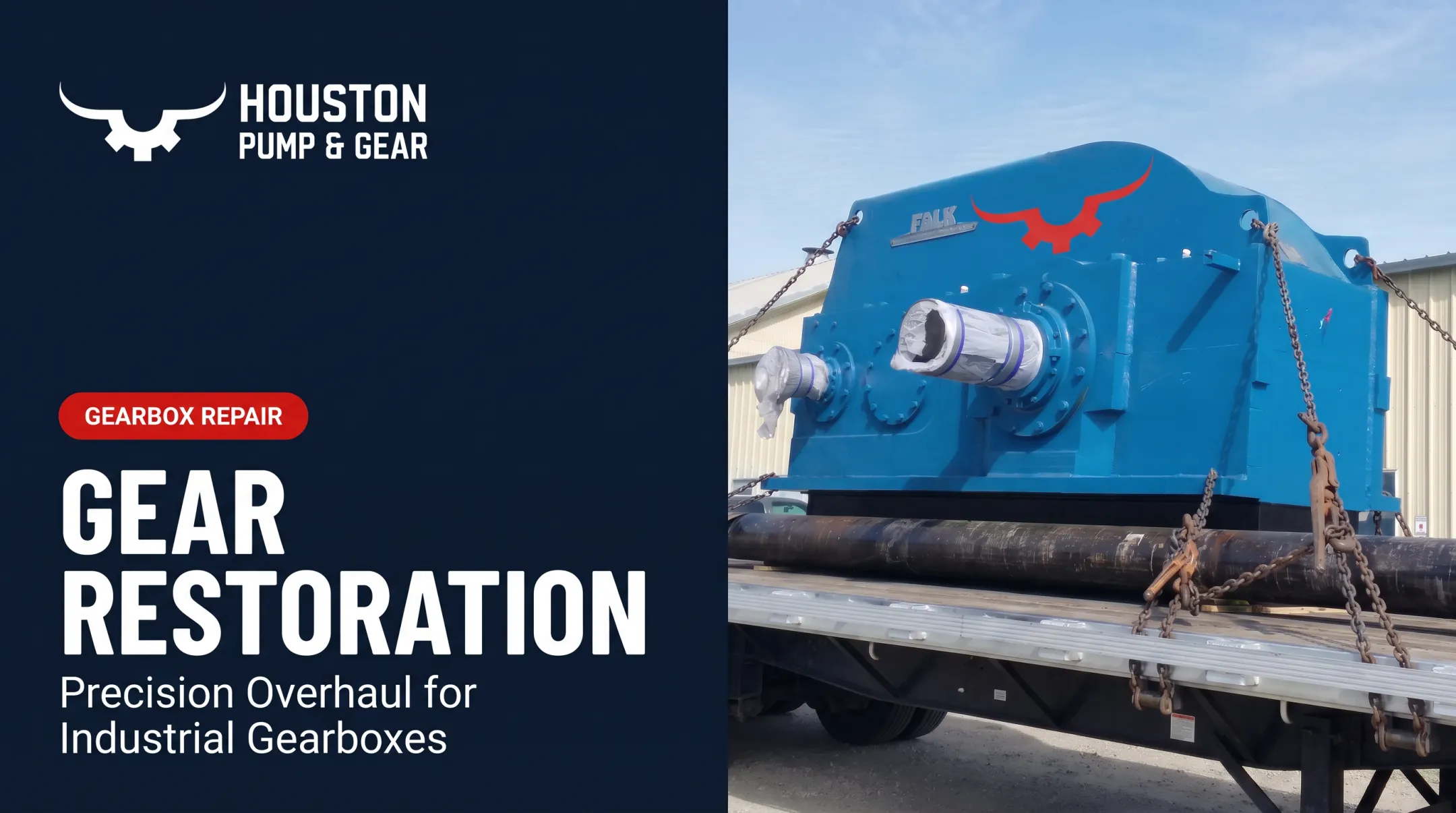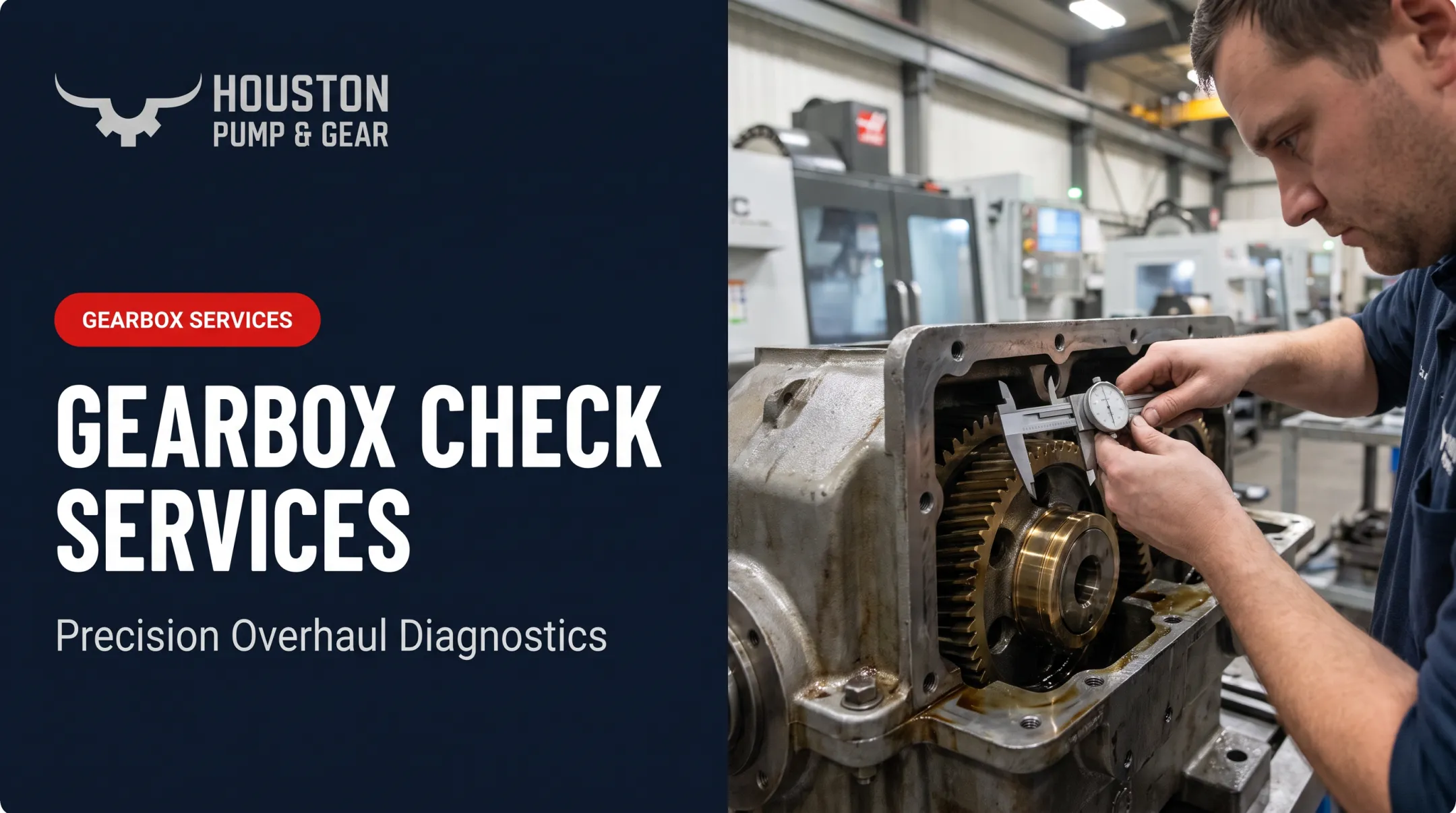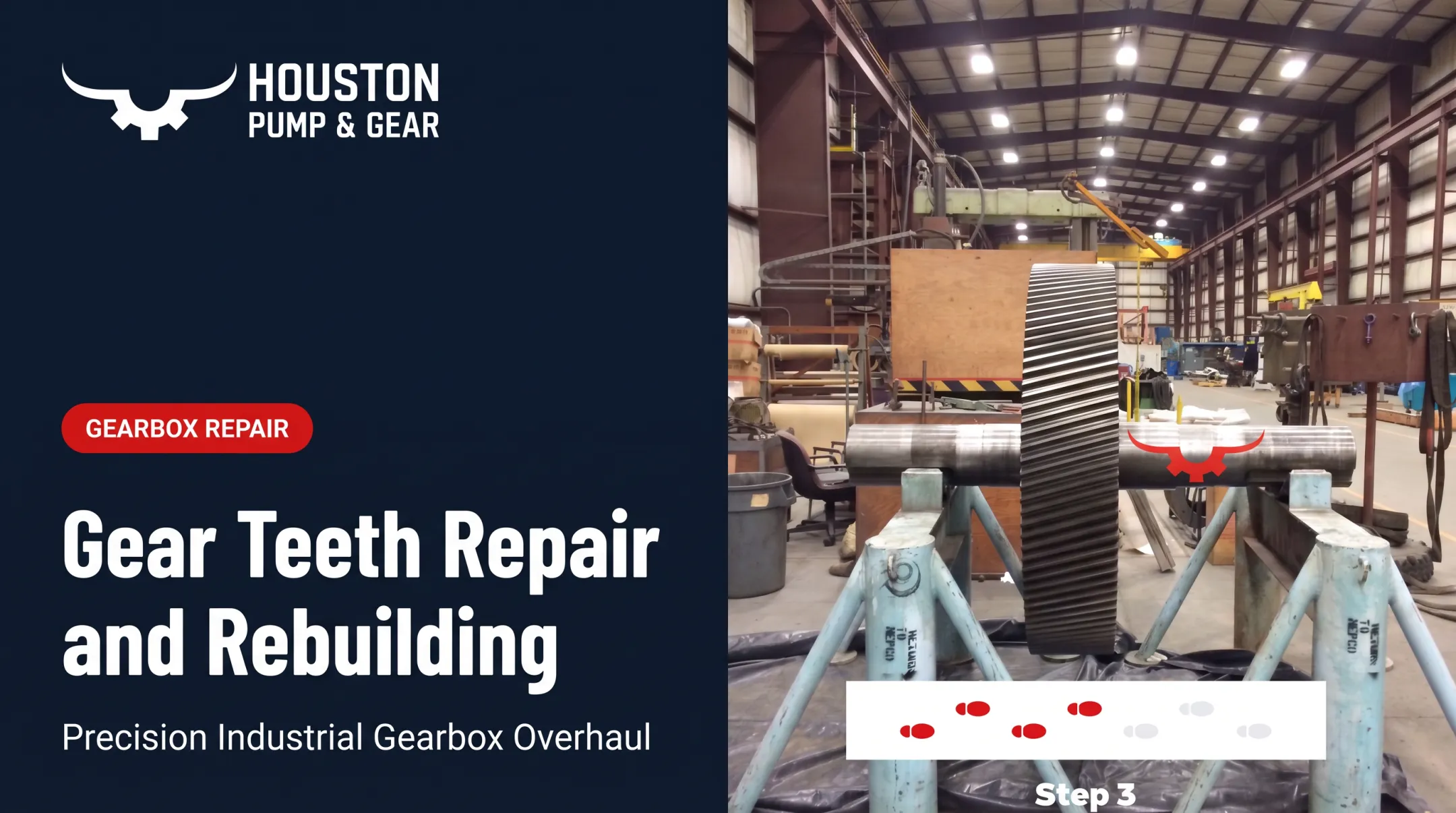

This guide covers the warning signs of gearbox failure, how to decide between repair and replacement, what a proper rebuild process looks like, and how to find a partner who can respond when it matters most. Houston Pump & Gear's 24/7 emergency response, including same-day pickup for critical failures, is a useful benchmark for what to look for.
Key Takeaways
- Repairing a broken gearbox typically costs 40-50% less than buying new
- Early detection of overheating, leaks, noise, and misalignment prevents catastrophic failure
- A full rebuild covers six steps: inspection, disassembly, failure analysis, repair, reassembly, and testing
- 24/7 emergency repair with mobile pickup can restore critical equipment in as little as 72 hours
Signs Your Gearbox Needs Repair
Overheating is the most common gearbox complaint. High RPM, continuous duty cycles, and side loads all generate excess heat. Watch for discoloration on housings, melted or warped components, and lubricant that's turned dark or gritty.
Leaks point to damaged seals or gaskets. Escaping lubricant invites contamination and accelerates bearing wear. Timken identifies inadequate lubrication, contamination, overload, and improper handling as the four most common conditions behind bearing damage. Bearings are often the first component to fail in a gearbox.
Misalignment shows up as uneven gear tooth wear and persistent vibration. Mounting shifts and thermal expansion are usually the culprits.
Abnormal noise usually means a problem is already underway:
- Squeaking often signals early lubrication issues
- Rattling points to loose components or worn gear teeth
- Grinding usually means gears are badly out of sync and need urgent attention
Overload damage happens when a gearbox exceeds its rated torque or thrust capacity. Some industrial units handle enormous loads; wheel drive gears, for example, can deliver up to 332,000 N·m of torque. Pushing past rated limits shortens lifespan fast.
If you notice vibration, overheating, unusual noise, or metal shavings in the lubricant, schedule an inspection immediately. Waiting turns a manageable repair into an emergency shutdown.

Repair or Replace? Making the Right Call
Choosing repair or replacement comes down to damage scope, total cost, and how long you can afford to be down.
Repair usually makes sense when:
- Damage is minor or localized to one or two components
- Cost is meaningfully lower than a new unit
- Turnaround needs to be fast
- OEM parts are obsolete or hard to find
Replacement becomes the better option when:
- Multiple components have failed catastrophically
- The design itself is outdated and can't be upgraded
- Repair costs approach replacement cost
For complex industrial models like Lufkin, Falk, and David Brown units, skilled rebuild shops can often restore original performance at a fraction of OEM replacement cost and lead time. Houston Pump & Gear services more than 200 OEM manufacturers and can reverse-engineer gears, shafts, and housings when original parts are no longer produced.
A commonly cited threshold: if repair estimates exceed roughly 75% of new-unit replacement cost, replacement becomes the more sensible path. Plant Engineering advises weighing failure cause, downtime cost, delivery time, and upgrade potential—not price alone.
Decision Checklist
- Damage severity — Is it isolated or widespread?
- Downtime tolerance — Can the facility wait weeks, or does it need days?
- Budget — Does repair stay well under 75% of replacement cost?
- Application criticality — Is this unit essential to continuous operations?
Turnaround often decides the call on its own:
- OEM factory repair: 16–18 weeks
- New unit lead time: 8–10 months
- Specialized rebuild shop: minor repairs in days; full rebuilds or custom machining in 1–2 weeks
- Emergency response: 24-hour options for critical failures
The Gearbox Repair and Rebuild Process, Step by Step
Initial Inspection and Diagnosis — Technicians evaluate exterior condition, check for noise and vibration, and provide a preliminary cost and time estimate based on prior work with similar units.
Full Disassembly and Documentation — Technicians break the gearbox down to bearings, bolts, gears, shafts, and casing. They label and assess every component individually.
Failure Analysis and Reporting — Technicians identify root causes such as poor lubrication, misalignment, or overloading. The client receives photos, findings, and a detailed quote before any work proceeds.
Machining, Repair, and Component Replacement — Worn gears, shafts, bearings, and seals are repaired or custom-remade to OEM specs. When parts are discontinued, reverse engineering fills the gap.
Reassembly and Precision Alignment — Technicians reinstall components following OEM procedures and verify torque, clearances, and alignment at each stage.
Quality Assurance Testing — No-load spin tests, vibration and noise checks, and backlash verification confirm the unit is ready before it returns to service.

Emergency work puts the full sequence on a clock. When a power plant's Lufkin S2212C gearbox failed and forced a shutdown, Houston Pump & Gear dispatched a truck the same day for pickup. The plant was back online within 72 hours.
Understanding Gearbox Repair Costs
Several factors drive what you'll pay for a rebuild:
- Extent of damage — Isolated wear costs far less than multi-component failure
- Part availability — Custom machining or reverse engineering adds time and cost when OEM parts are discontinued
- Gearbox size and complexity — Larger, more specialized units require more labor and precision
- Turnaround urgency — Emergency service typically carries a premium over standard scheduling
A repair or rebuild generally runs 40-50% less than buying a comparable new unit. That gap widens further for large or custom gearboxes, where sourcing an exact OEM replacement can be difficult or impossible.
Before approving any work, insist on a documented failure analysis and an itemized quote. Reputable shops spell out which parts need replacement and why up front, so you see full scope before committing budget instead of finding new costs mid-repair.
Why Emergency Response Time Matters for Power Plants and Heavy Industry
Every hour a gearbox sits idle costs a power plant or industrial facility real money, not only in lost production but in knock-on delays across the facility. Response time is what separates a repair partner you can call at 2 a.m. from one that makes you wait until Monday.
Houston Pump & Gear operates 24/7, with dedicated trucks and drivers ready for mobile pickup — no waiting for a standard business-hours callback during a middle-of-the-night failure. The team has experience with complex industrial models across Texas and Louisiana, from Falk and Flender to Lufkin and Horsburgh & Scott units.

Jerry Storm saw that difference firsthand. When his power plant's Lufkin S2212C gearbox failed and triggered an emergency shutdown, Houston Pump & Gear picked up the unit the same day. The plant was operational again within 72 hours.
"The customer service, quality of work, and turnaround time were amazing." — Jerry Storm
That relationship didn't end with one repair. Storm has since had over 15 units serviced by the company — emergency response that holds up under pressure is what turns a single save into ongoing work across a fleet.
Frequently Asked Questions
How much does it cost to repair a gearbox?
Cost depends on damage severity, gearbox size and complexity, and parts needed. Repair typically costs 40–50% less than buying a comparable new unit.
Can a gearbox be repaired?
Most gearboxes can be repaired by a qualified shop and restored to original performance. Repair may not be practical when damage is catastrophic or spans multiple major components.
Is it better to repair or replace a gearbox?
Repair is usually the better choice for cost and speed. Replacement makes more sense when damage is severe and widespread, or the unit is truly obsolete.
How do you know if a gearbox is bad?
Common symptoms include overheating, oil leaks, unusual noise (grinding, rattling, squeaking), vibration, and visible metal shavings in the lubricant. Any of these signs warrants a professional inspection.
What is included in a professional gearbox rebuild?
A professional rebuild includes disassembly, cleaning, failure analysis, repair or replacement of worn parts, precision reassembly, and quality testing before the unit returns to service.
How fast can an emergency gearbox repair be completed?
With 24/7 mobile response and a dedicated shop, emergency repairs can be completed in as little as 72 hours, depending on the extent of the damage.