
Wear, cavitation, misalignment, and skipped maintenance all catch up to a pump eventually. When they do, the result is often unplanned downtime that costs far more than the repair itself.
This guide covers the most common centrifugal pump problems, how to diagnose and fix them, when to repair versus replace, and when it's time to call in a team like Houston Pump & Gear.
TL;DR
- Most common issues: low flow, vibration, seal leaks, and overheating or bearing failure
- Repair vs. replace: seals, bearings, and impellers are usually fixable without a full unit swap
- Fix process: diagnose the symptom, confirm root cause, repair, then test under load
- When to call a pro: symptoms persist after basic checks, or you face a critical plant or refinery shutdown
What Is a Centrifugal Pump?
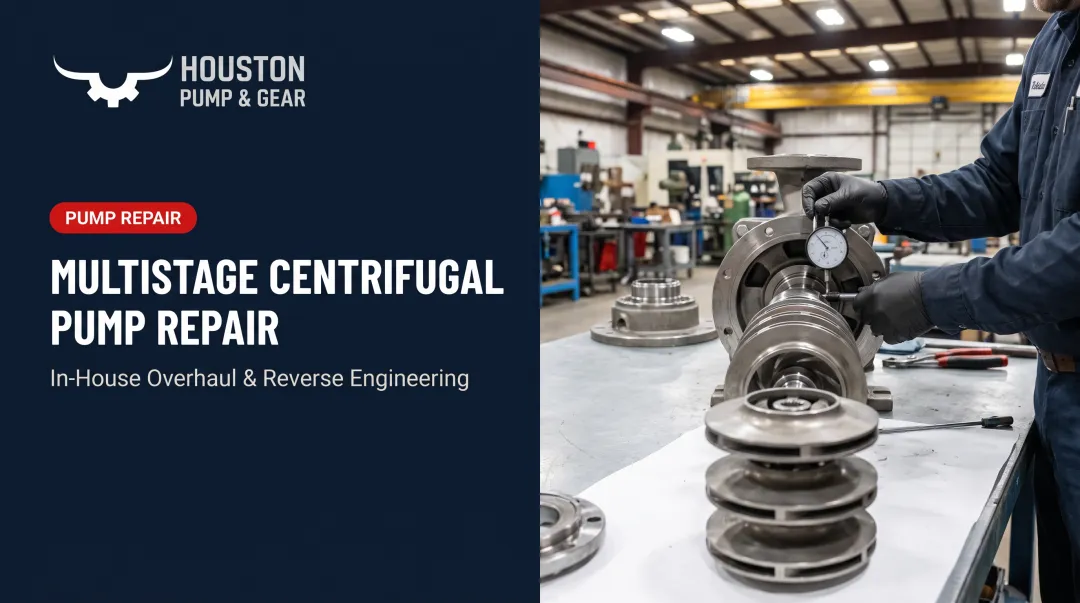
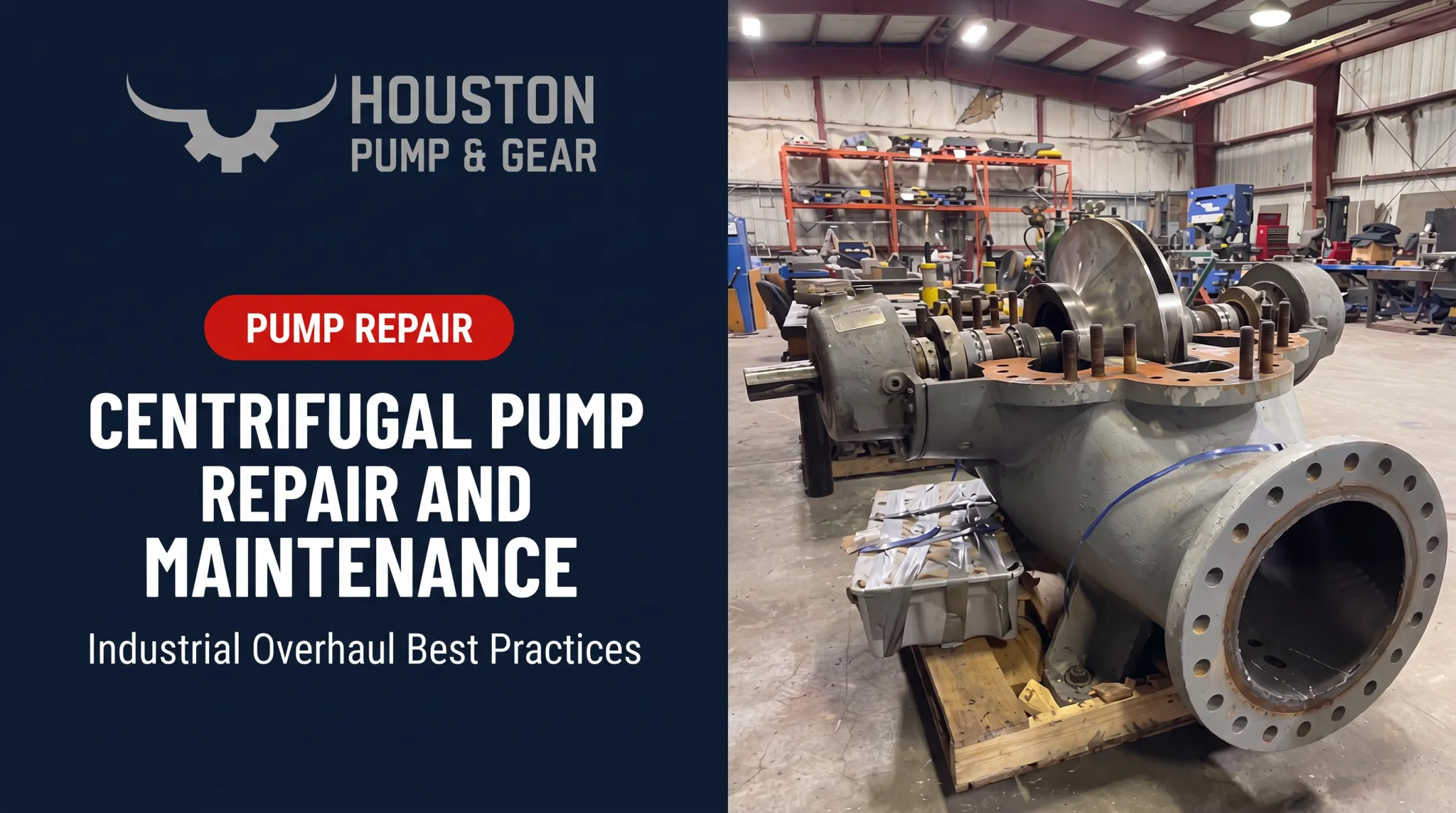
A centrifugal pump uses a rotating impeller to convert mechanical energy into kinetic energy, pushing fluid outward through centrifugal force. The casing captures that energy and directs the fluid where it needs to go.
Every centrifugal pump breaks down into two functional groups:
- Wet-end components: impeller and casing — the parts that actually contact and move fluid
- Mechanical-end components: shaft, mechanical seals, shaft sleeve, and bearings — the parts that support rotation and prevent leakage
The impeller itself has two or more curved vanes that fling fluid outward as it spins.
Every one of these components wears down over time. Seals dry out, bearings lose lubrication, and impellers erode from abrasive fluids. That is why centrifugal pumps need periodic repair—before a failure shuts a line down, not only after something breaks.

Common Problems With Centrifugal Pumps
Most centrifugal pump failures aren't random. They follow patterns tied to a small handful of components. Catching symptoms early makes diagnosis faster, repairs cheaper, and unplanned downtime shorter.
Reduced or No Flow
Symptoms: Weak discharge, inconsistent output, or a pump that runs but doesn't deliver fluid. Likely causes:
- Clogged impeller or suction line
- Trapped air pockets or worn impeller
- Loss of prime from poor flooded suction or priming setup Most centrifugal pumps need a full prime before start-up. If suction conditions don't keep the casing filled, flow drops off immediately.
Excessive Vibration or Noise
Symptoms: Rattling, grinding, or humming louder than normal operation. Likely causes:
- Shaft misalignment
- Cavitation from low suction pressure
- Bent or damaged impeller
- Worn bearings Cavitation starts when local pressure drops below the fluid's vapor pressure. Vapor bubbles form, then collapse hard against the impeller and casing. It is one of the most common pump failure modes and almost always traces back to poor maintenance or incorrect suction conditions.
Leaks at Seals or Casing
Symptoms: Visible fluid pooling, dripping near the shaft seal, or moisture around gasket joints. Likely causes:
- Worn mechanical seals
- Damaged gaskets or loose fasteners
- Dry running, misalignment, or improper seal install
- Heat, abrasives, or chemical incompatibility Bearing wear can throw the shaft off-center and open a leak path at the seal. The two problems often show up together.
Overheating or Bearing Failure
Symptoms: A bearing housing that's hot to the touch, an unusual smell, or frequent trips on the drive. Likely causes:
- Insufficient lubrication
- Misalignment or excessive friction
- Blocked cooling paths Left alone, a hot bearing progresses to vibration, seal damage, and a hard shutdown — the kind of outage that idles a line or unit until the pump is rebuilt.
Why Centrifugal Pumps Fail (Root Causes)
Most centrifugal pump failures trace back to a few real-world conditions:
- Operational stress: running the pump outside its best efficiency point or under continuous heavy load
- Environmental exposure: corrosive fluids, humidity, or dirty suction sources that degrade materials over time
- Improper installation: misalignment or poor coupling setup at commissioning that transfers vibration and wear through the pump and motor
- Lack of preventive maintenance: skipped lubrication, inspections, or seal checks
Oil & gas, manufacturing, chemical, and water treatment facilities are especially prone to these issues because their pumps face high pressure, variable temperatures, and abrasive materials daily.
Left unaddressed, early warning signs usually lead to:
- Reduced flow and efficiency, driving up energy costs
- Product quality or process disruptions across the plant
- Safety and compliance risks from leaks or catastrophic seal/bearing failure
- Expensive unplanned downtime and emergency shutdowns
How to Fix a Centrifugal Pump (Step-by-Step)
Jumping straight to a fix without confirming the actual problem wastes time and often causes repeat failures. A disciplined process gets it right the first time.
Step 1: Identify the Exact Problem
Start by observing what's actually happening:
- Note visible symptoms — leaks, noise, vibration, overheating, or reduced output
- Compare current performance against baseline flow, pressure, or amp draw readings
- Check gauges, alarms, or control system indicators for abnormal values
- Document when the issue shows up: at startup, under load, or during continuous run time
Step 2: Confirm the Root Cause Category
Narrow down whether the issue is mechanical (impeller, bearing, seal), electrical (motor), or operational/environmental (cavitation, suction conditions). Rule out external factors like power supply problems or piping strain. Don't replace parts until the cause is confirmed. Guessing is what drives repeat failures.
Step 3: Fix the Pump Based on the Diagnosis
If it's mechanical: Common failures include worn impellers, damaged bearings, and degraded mechanical seals. Typical repair actions:
- Inspect or replace the impeller
- Pull and reinstall bearings
- Replace mechanical seals and matching O-rings Always check shaft alignment and runout before reassembly. If it's electrical or motor-related: Check voltage, amperage, and terminal connections. Confirm correct rotation direction and recalibrate sensors as needed. If it's operational or environmental: Insufficient NPSH, air leaks in the suction line, or poor fluid quality are common culprits. Corrective actions include:
- Adjusting suction conditions to restore adequate NPSH
- Sealing air leaks in the suction line
- Cleaning strainers and addressing fluid quality issues Revise operating procedures where needed so the same conditions don't return.
Step 4: Test and Validate the Repair
Run the pump under normal and peak load. Monitor flow, pressure, vibration, and bearing temperature against baseline benchmarks. Confirm motor performance and pump flow before returning the unit to service. When the repair is beyond in-house scope—or downtime is critical—Houston Pump & Gear provides mobile pickup and 24/7 turnaround, with a demonstrated 72-hour emergency repair track record on complex industrial equipment.

When Should You Fix vs. Replace a Centrifugal Pump?
Cost, downtime risk, and long-term performance drive the call. Use the scenarios below to match the failure mode to repair or replacement.
| Scenario | Fix | Replace |
|---|---|---|
| Isolated seal or bearing wear | Replace the seal or bearing if the casing and impeller are intact | Replace the pump if shaft or housing damage makes repair uneconomical |
| Reduced flow from impeller wear | Repair or replace the impeller if casing tolerances hold | Replace if casing wear exceeds manufacturer tolerances |
| Repeated failures on an aging unit | Repair when the root cause is isolated and the rest of the pump is sound | Replace when breakdowns keep recurring and the unit is near end of life |
| Emergency shutdown at a power plant | Emergency repair if a rapid-response team can restore it fast enough | Replace if damage is catastrophic and repair would take longer than sourcing a replacement |
Houston Pump & Gear starts by matching the application to a spec sheet, CAD drawing, or original part sample, then inspecting the unit to pin down why it failed. The inspection report and repair cost estimate give facilities a clear view of failure cause, repair scope, cost, and downtime so they can make the fix-or-replace call on facts.
Common Mistakes to Avoid When Fixing a Centrifugal Pump
Even experienced maintenance teams fall into these traps:
- Treating symptoms instead of root causes: replacing a seal repeatedly without figuring out why it keeps failing (often it's a bearing or alignment issue upstream)
- Skipping post-repair testing: returning a pump to service without validating it under real operating loads
- Using incompatible parts: seals, bearings, or gaskets that aren't matched to OEM specs usually fail again sooner
Preventive Measures to Avoid Future Issues
Preventive maintenance costs less than emergency repair, every time. A solid program includes:
- Regular inspection of bearings, seals, and vibration levels
- Scheduled lubrication and alignment checks
- Proper suction conditions maintained to avoid cavitation
- Staff training and documented maintenance history for faster diagnosis
Small habits—checking bearing temperature, listening for unusual noise, tracking lubrication—catch problems long before they become shutdowns. When checks show rising vibration, repeated seal leaks, or performance drop-off beyond routine adjustment, schedule a professional pump inspection or overhaul before a forced outage hits production.

Conclusion
Most centrifugal pump issues are fixable, provided they're caught early and diagnosed correctly. Guessing at repairs, or replacing parts without confirming the root cause, almost always leads to the same failure showing up again.
For power plants and heavy industry across Texas and Louisiana, knowing when to repair versus replace is only half the equation. A 24/7 partner like Houston Pump & Gear on call is what keeps a maintenance event from turning into an extended, costly shutdown.
Frequently Asked Questions
How is a centrifugal pump repaired?
Repair follows a diagnose-isolate-repair-test process: identify the symptom, confirm the root cause, apply the fix, then validate performance under load. Repairs range from seal or bearing replacement to full impeller machining, depending on what's actually wrong.
What is the average lifespan of a centrifugal pump?
Lifespan varies widely based on maintenance quality, operating conditions, and how demanding the application is. Rather than a fixed number, judge a pump by current condition, repair history, and reliability, not age alone.
Can a centrifugal pump be repaired without replacing the whole unit?
Yes. Most wear components (seals, bearings, and impellers) can be repaired or replaced individually without swapping out the entire pump, as long as the casing and shaft are still in good condition.
What causes a centrifugal pump to lose prime?
The usual culprits are air leaks in the suction line, an incompletely filled suction pipe, or trapped air in the casing. Checking suction joints and fittings for airtightness is the first troubleshooting step.
How often should a centrifugal pump be inspected?
Daily visual checks catch obvious issues like leaks or noise. Monthly lubrication checks and periodic (roughly six-month) full inspections catch wear before it becomes failure.
Who should I call for emergency centrifugal pump repair?
Call a 24/7 industrial repair partner with mobile field response. Houston Pump & Gear serves power plants and heavy industry across Texas and Louisiana with emergency service and rapid pickup.