
Shaft damage rarely happens overnight. Friction, corrosion, misalignment, and constant contact with seals and bearings wear shafts down in predictable, recognizable ways. Catching that pattern early is often the difference between an afternoon fix and a week-long shutdown.
This guide covers the most common shaft problems, what causes them, a step-by-step repair process, and how to decide whether a shaft is worth fixing or needs to be replaced. We'll also touch on when it's time to call an emergency repair specialist instead of scheduling a routine shop visit.
Key Takeaways
- Most shaft problems (scoring, wear, minor bending, corrosion) can be repaired without full replacement
- Match the repair method to the damage type: surface wear, misalignment, corrosion, or fatigue
- Replace cracked or severely fatigued shafts on critical rotating equipment
- Experienced shops can turn around emergency shaft repairs in days, not weeks
Common Shaft Problems and Why They Happen
Most shaft failures in pumps, gearboxes, and other rotating equipment trace back to a handful of recurring operating conditions. Spotting the pattern early keeps a small fix from turning into a major one.
Worn or Scored Shaft Surface
- Symptoms: A visible groove at the seal contact point, oil or process fluid leaking past the seal, or a raised or rough wear ring on the shaft
- Likely cause: Abrasive particles trapped under a seal acting like grinding compound, or years of ordinary friction from seal and bearing contact
Corroded or Pitted Shaft
- Symptoms: Rust, surface pitting, a reduced diameter, or a rough, uneven texture along the shaft
- Likely cause: Moisture exposure, aggressive process chemicals, or submerged or partially submerged operation without adequate protection
Bent or Misaligned Shaft
- Symptoms: Excessive vibration, uneven wear on bearings or couplings, unusual noise that shows up under load
- Likely cause: Shock loading, improper installation, or sustained operation outside alignment tolerances
Cracked or Fatigued Shaft
- Symptoms: Visible cracking, a sudden spike in vibration, repeated failure at the exact same location
- Likely cause: Cyclic stress accumulated over years of service, a material defect, or an overload condition that went undetected
Ignoring any of these doesn't just risk another shaft failure. Bearings and seals go next, followed by reduced efficiency and, eventually, a full outage.
Unplanned downtime carries an average annual impact of $20 billion in process industries — nearly 5% of total production, according to ARC Advisory Group's 2016 industry analysis. A groove that takes an afternoon to fix now can become a week-long shutdown later.

How to Repair a Shaft: Step-by-Step Guide
Jumping straight to a fix before confirming the damage type is how shafts end up back on the bench a month later. A structured diagnosis ensures the repair addresses the actual problem, not just its symptom, so it doesn't recur.
Step 1: Identify the Exact Problem With the Shaft
- Inspect visually for grooves, pitting, corrosion, or visible bending
- Measure diameter at multiple points with calipers or a micrometer and compare against OEM specification
- Check runout with a dial indicator to catch bending or eccentricity the eye can't see
- Document where and when damage appears: seal contact point, bearing journal, coupling area, at startup, or under continuous load
Runout limits aren't universal. Flowserve's seal installation guidance calls for 0.05 mm (0.002 in.) TIR on shafts with ball or roller bearings, but sleeve-bearing designs follow separate OEM specifications. Always check the applicable drawing rather than assuming a generic number.
Step 2: Confirm the Root Cause Category
Narrow the problem before picking a repair method: surface wear or corrosion, mechanical bending or misalignment, or structural cracking and fatigue. Rule out contributing factors too. Seal quality, lubrication, bearing condition, and installation alignment all play a part.
This step prevents two costly mistakes: applying a cosmetic fix to a structurally compromised shaft, or replacing one that only needed a sleeve or a rebuild.
Step 3: Fix the Shaft Based on the Identified Problem
The repair method depends entirely on what's actually wrong. This is where cost, downtime, and long-term reliability get decided.
Surface wear or scoring (typically at seal or bearing contact points):
- Undercut the worn section and degrease it
- Rebuild with a compatible metal-repair epoxy, weld overlay, or repair sleeve
- Machine back to OEM tolerance, checking diameter, smoothness, and squareness before reassembly
Bent or misaligned shafts (usually from shock loads or improper installation):
- Apply mechanical or heat straightening for shafts within tolerance limits
- Verify runout afterward
- Confirm alignment with couplings and bearings before returning the shaft to service
Corrosion or pitting (common in submerged, marine, or chemically exposed applications):
- Clean back to sound base metal
- Rebuild pitted areas with corrosion-resistant epoxy or metal fill
- Machine to spec and consider a protective coating going forward
- Verify no active corrosion remains before final machining
Cracks or fatigue damage:
- Use non-destructive testing (dye penetrant or magnetic particle inspection) to assess crack depth and extent
- On safety-critical rotating equipment, this is usually where replacement wins out over repair (more on that in the next section)
Step 4: Test and Validate the Repair
- Re-check dimensions, runout, and surface finish against OEM tolerances
- Reassemble with new seals and bearings as needed
- Run the equipment under normal load, then peak load
- Monitor vibration, noise, and temperature throughout the test run

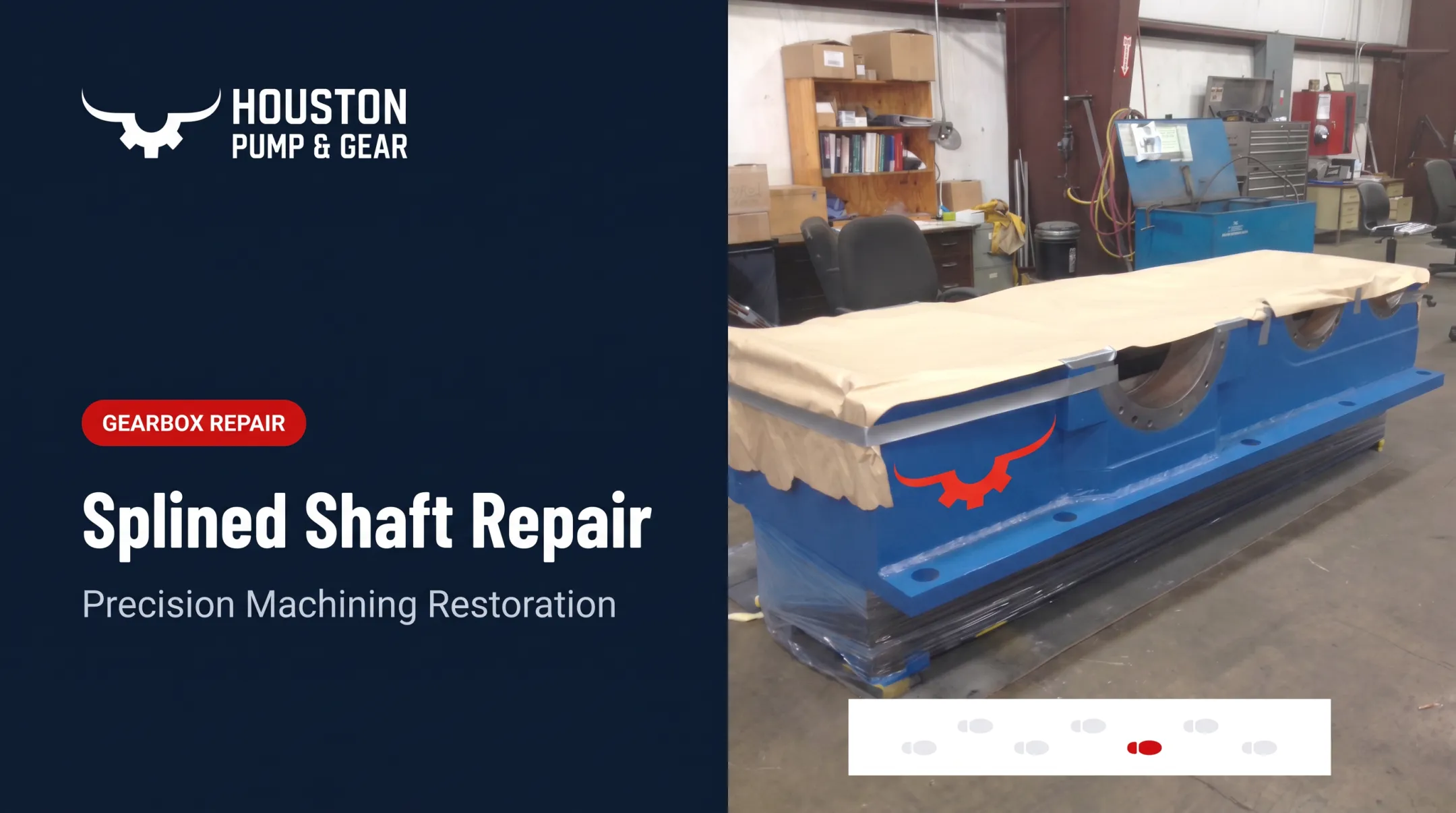
For complex industrial shafts, the kind buried inside a power plant gearbox, this step isn't optional. Houston Pump & Gear combines full teardown, precision machining, and reassembly to validate a repair before equipment ships back out. That process was tested on a Lufkin S2212C gearbox: a power plant client hit an emergency shutdown, a truck was dispatched the same day, and the unit was back in service 72 hours later.
When Should You Fix vs Replace a Shaft?
Weigh three things before deciding: repair cost, how critical the equipment is, and long-term reliability.
| Scenario | Fix When | Replace When |
|---|---|---|
| Minor surface wear or a single groove | A sleeve or epoxy rebuild restores the sealing surface within hours | Wear extends across multiple critical journals |
| Non-critical, low-load application | A repair sleeve or weld build-up works well on lighter-duty equipment | Repeated failures make ongoing repair costlier than a new shaft |
| Bent shaft on critical equipment (pumps, gearboxes, turbines) | The bend is minor and within OEM runout tolerance | The bend risks recurring vibration or bearing damage |
| Cracked, fatigued, or severely corroded shaft | Rarely advisable; the safety risk is too high | Required, especially where failure could trigger extended shutdowns |
No responsible shop applies one blanket rule to every shaft. Houston Pump & Gear bases each repair-versus-replace call on inspection findings (wear depth, alignment data, and whether the shaft can still meet OEM performance specs) rather than a generic cutoff.
Mistakes to Avoid & Preventive Maintenance
A few recurring mistakes turn a fixable shaft problem into a repeat failure:
- Treating a leak as a seal problem without confirming whether the shaft itself is scored or worn underneath
- Skipping runout and dimensional checks after a repair, which risks premature failure down the line
- Using incompatible repair materials — a sleeve, filler, or weld not rated for the shaft's operating temperature or chemical exposure
Preventing the problem beats repairing it. Build these habits into routine operations:
- Schedule regular shaft and seal inspections
- Maintain proper lubrication and alignment
- Document wear patterns so issues surface before failure
Facilities that adopt predictive maintenance report 70–75% fewer breakdowns and 35–45% less downtime, according to the U.S. Department of Energy's Operations & Maintenance Best Practices Guide.

Those figures are industrial survey averages, not guarantees. Still, the direction holds: catching shaft wear on a scheduled inspection beats finding it during an unplanned shutdown.
Conclusion
Most shaft issues — wear, scoring, minor bending, corrosion — are repairable if you catch them early and diagnose them correctly. The repair method matters less than getting the root cause right; that's what determines whether a fix lasts five years or five weeks.
For critical industrial and power plant equipment, the shop you call matters just as much. Houston Pump & Gear operates as a 24/7 emergency repair partner across Texas and Louisiana. The gap between hours of downtime and days of lost production usually comes down to how fast that call gets answered.
Frequently Asked Questions
Is a drive shaft expensive to fix?
Cost depends on damage depth, shaft size, and how fast you need the unit back online. Surface fixes like sleeves or epoxy rebuilds stay relatively low-cost; large industrial machining costs more but often beats full replacement when downtime is factored in.
Can a worn shaft be repaired without replacing it entirely?
In most cases, yes. Surface wear and scoring can typically be fixed with a sleeve, weld overlay, or epoxy rebuild, provided the damage isn't too deep or structural.
How long does a typical shaft repair take?
Minor surface repairs can be done in hours. Complex industrial shaft or gearbox rebuilds usually take one to three days with a shop set up for rapid turnaround.
Can a bent shaft be straightened, or does it need replacement?
Minor bends within tolerance can usually be straightened and returned to service. Severe bends risk repeat failure and are generally better replaced.
What's the difference in cost between repairing and replacing a shaft?
A sleeve or rebuild usually costs a fraction of a new shaft once machining and downtime are included. Replacement is the better long-term choice only when the shaft is cracked, twisted beyond tolerance, or otherwise structurally compromised.
How do I know if my shaft needs emergency repair?
Watch for sudden vibration spikes, leaking seals, unusual noise, or visible cracking. Shut the equipment down and get a professional inspection right away—damage spreads quickly to bearings and seals if you keep running.