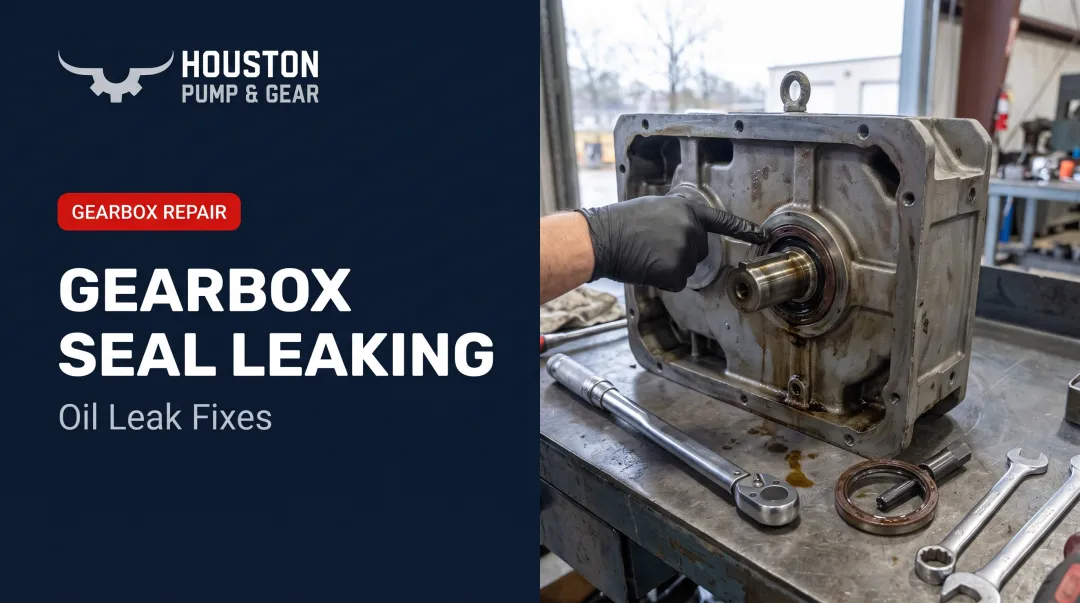

Seal issues creep up over time. Heat, misalignment, wear, and missed inspections all take a toll, and a leak that looks minor on Monday can become a full gearbox failure by Friday. This guide walks through the most common seal problems, why they happen, how to fix them step by step, and when repair beats replacement. We'll also cover when it's time to call in a team like Houston Pump & Gear for emergency support.
TL;DR
- Most seal failures follow a few patterns: oil leaks, hardened seals, contamination, or misalignment wear
- Simple wear is often an on-site fix; shaft damage or repeat leaks usually need a full teardown
- Work in order: diagnose the symptom, isolate the root cause, replace the seal, then test under load
- Call 24/7 emergency support when a leak threatens continuous power plant or industrial operations
What Is a Gearbox Seal?
A gearbox seal is a rubber or silicone lip seal, usually reinforced with a garter spring, that sits between the rotating shaft and the stationary housing. SKF defines this as a radial shaft seal — the outer edge seals statically against the housing, while the inner lip seals dynamically against the moving shaft.
That spring-loaded lip does two jobs at once:
- Keeps lubricant inside the housing so gears and bearings stay properly oiled
- Blocks dirt, dust, and moisture from getting in and damaging internal components
Seals aren't built to last forever. They're a wear component, degrading gradually with heat and friction. Houston Pump & Gear's technicians measure and document every seal during a gearbox inspection, because early wear is far cheaper to fix than a leak or contamination failure.

Common Problems With Gearbox Seals
Most seal failures in industrial settings follow a handful of predictable patterns. Here's what to watch for.
Oil Leaks Around the Shaft
Symptoms: Visible oil pooling near the shaft, residue on the housing exterior, or a gradually dropping oil level.
Likely cause: A worn seal lip, grooves cut into the shaft surface, or excessive internal oil pressure pushing past the seal.
Hardened or Cracked Seal Material
Symptoms: Brittle, cracked rubber — often noticed after a long idle period when the unit starts back up and immediately leaks.
Likely cause: Prolonged heat exposure. According to Noria's research on lip seals, nitrile seal life drops by roughly half for every 57°F increase in operating temperature. That's a steep curve for gearboxes running hot for years.
Contamination Inside the Gearbox
Symptoms: Gritty or discolored oil, faster-than-normal gear wear, unusual grinding noise.
Likely cause: A failed seal letting dirt or moisture into the housing. Something as small as a speck of grit or a trace of water can cause outsized damage once it's inside a gearbox.
Premature Seal Wear from Vibration or Misalignment
Symptoms: Leaks reappearing shortly after a fresh seal install, or an uneven wear pattern visible on the seal you just pulled out.
Likely cause: Shaft misalignment, worn bearings allowing radial play, or a seal that was installed slightly crooked the first time.

Why Gearbox Seals Fail (Root Causes)
Seal failures almost always trace back to operating conditions. A few real-world factors drive most of them:
- Continuous heavy-duty operation: gearboxes in power plants and heavy industry rarely get a break, and that sustained stress accelerates wear
- Environmental exposure: heat, dust, and moisture are just part of the job in most plant environments
- Improper installation: a seal seated crooked, or the wrong size or type entirely, can leak from day one
- Skipped oil analysis and inspection: problems that would've been caught early instead go unnoticed until they're expensive
Noria identifies excessive temperature as the single leading cause of seal failure, ahead of contamination or installation error. That's worth remembering the next time a crew shelves a "minor" heat issue.
What happens if you ignore a seal problem?
- Lubrication efficiency drops, and gear wear accelerates
- Contamination degrades output quality and consistency
- Safety and compliance risks increase in power generation settings
- Unplanned downtime turns into a costly emergency shutdown
How to Fix a Gearbox Seal (Step-by-Step)
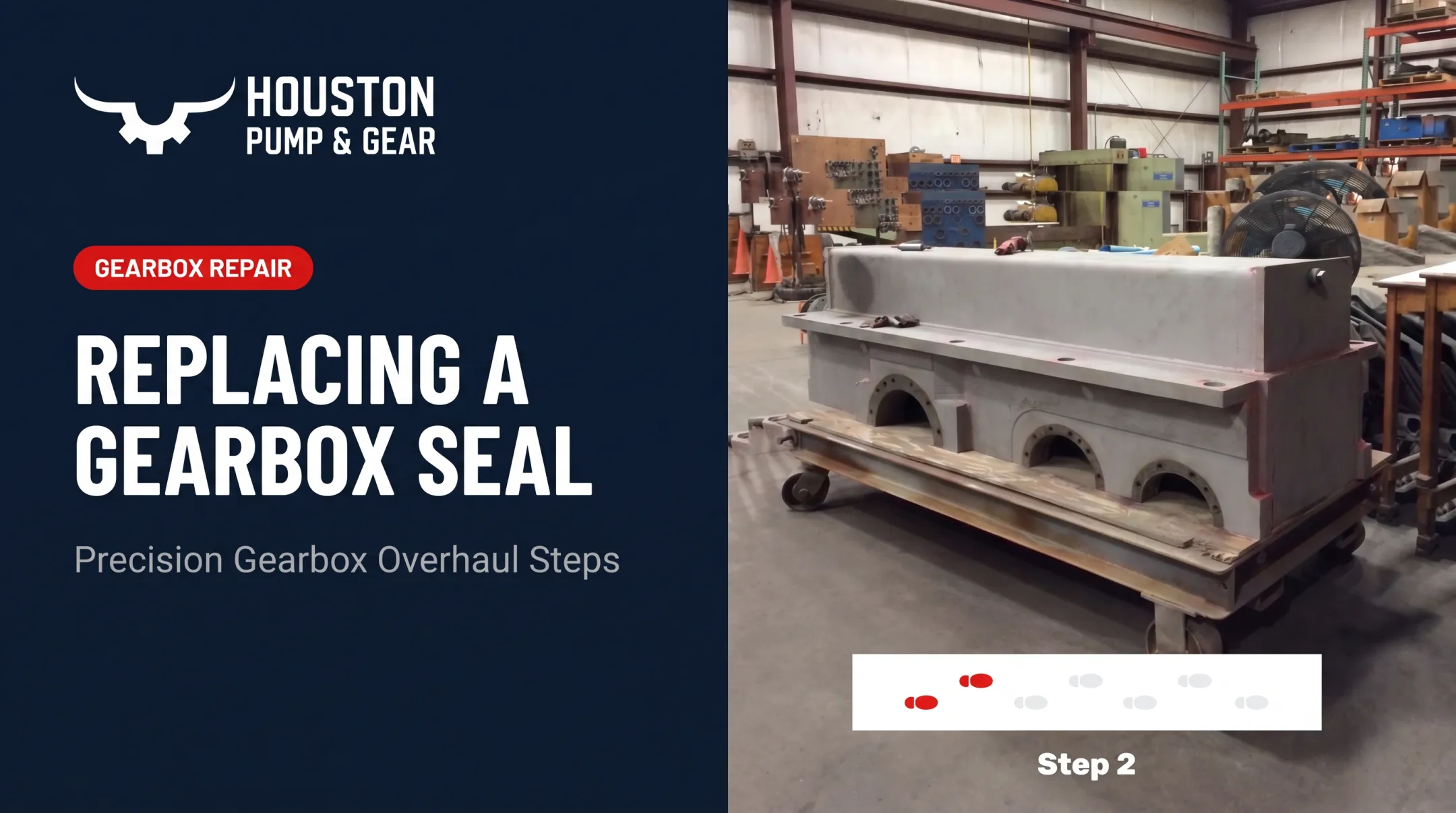
Swapping a seal without diagnosing why it failed is how you end up doing the same repair again in three months. A proper fix identifies the real problem, isolates the cause, applies the right correction, and confirms it holds.
Step 1: Identify the Exact Problem
Start by gathering evidence:
- Note the leak's exact location, and check oil color and consistency
- Track how fast oil level drops and whether leaks reappear after a previous fix
- Check monitored gearboxes for alarms or abnormal readings
- Document when the leak occurs — at startup, under load, or during continuous run
Step 2: Confirm the Root Cause Category
Before touching the seal, determine which category you're dealing with:
- Seal wear or age
- Shaft or bearing damage
- Misalignment or vibration
- Contamination
Rule out simpler explanations first, such as the wrong oil type or an overfilled housing. Replacing the seal alone when the shaft is scored just guarantees a repeat failure.
Step 3: Fix the Seal Based on the Root Cause
If it's simple wear or age:
- Remove the old seal with a seal puller, taking care not to gouge the housing
- Clean the housing bore thoroughly
- Lubricate the new seal and press it in squarely using a driver matched to its diameter
- Check the shaft surface for grooves before final seating
If shaft or bearing damage is the culprit:
- Inspect the shaft at the seal contact point for scoring or wear grooves
- Consider a wear sleeve, such as SKF's Speedi-Sleeve, which fits over a worn shaft area without requiring disassembly or machining
- Replace any bearings allowing excess shaft movement
If misalignment or vibration is the cause:
- Check coupling and mounting alignment against spec
- Correct alignment and re-torque mounts
- Log baseline vibration readings after the repair for future comparison

Step 4: Test and Validate the Fix
Refill with the correct gear oil type and quantity, then run the gearbox under normal load. Watch for leaks over the first few hours, then again at 24-48 hours. Compare oil temperature, noise, and vibration against expected benchmarks.
For critical equipment, this validation step matters most. Houston Pump & Gear's field team confirms every repair on-site before a unit returns to service. That approach supported a 72-hour emergency turnaround on a Lufkin S2212C gearbox, restoring a power plant after an unplanned shutdown.
When Should You Fix vs Replace a Gearbox Seal?
The right call depends on repair cost, downtime risk, and long-term reliability. Use this matrix to separate a seal-only job from work that needs rebuild or exchange.
| Scenario | Seal-focused fix | Broader replace / rebuild |
|---|---|---|
| Isolated seal wear, no shaft damage | Simple seal swap is enough | Not needed unless housing is damaged too |
| Repeated leaks after prior seal replacements | Correct shaft, bearing, or misalignment first | Full rebuild if internals are also worn |
| Older gearbox with multiple wear indicators | Temporary seal fix buys limited time | Full overhaul or refurbished exchange is often more cost-effective |
| Emergency shutdown at a power plant | Rapid-response seal repair to restore operations fast | Only if teardown shows irreparable internal wear |
On Flender helical units and similar industrial gearboxes, scope still runs from a seal-and-bearing swap to a complete rebuild. Inspection results set that scope before parts are ordered or the unit is exchanged.

Common Mistakes to Avoid When Fixing a Gearbox Seal
A few missteps show up again and again in the field:
- Treating the symptom, not the cause: swapping the seal without checking the shaft, bearings, or alignment
- Skipping post-repair monitoring: a leak that reappears in week two often means the root cause was missed
- Using the wrong seal: incorrect size or material type leads to immediate or premature failure
- Ignoring lockout/tagout procedures: failing to isolate and de-energize per OSHA's 1910.147 standard before teardown is a serious safety risk
Preventive Measures to Avoid Future Seal Issues
Catching seal wear before it becomes a leak is almost always cheaper than an emergency repair. A few habits make the biggest difference:
- Scheduled oil analysis: routine sampling flags contamination or lubricant breakdown before it damages gears
- Vibration monitoring and alignment checks: shaft runout drives seal wear; catching it early prevents repeat failures
- Proper oil type, level, and change intervals: low oil can harden a seal so it no longer tracks the shaft
- Proactive inspection support: Houston Pump & Gear’s mobile field response and transport trucks help catch small issues before an emergency shutdown
Conclusion
Most gearbox seal problems are fixable, provided they're caught and diagnosed correctly. The seal itself is rarely the whole story — shaft wear, misalignment, and contamination are often the real drivers, and a lasting repair has to address them directly instead of just swapping parts.
Knowing when a simple fix will hold and when a full rebuild makes more sense saves both money and downtime. When equipment fails without warning, a 24/7 partner on call keeps a bad day from turning into a bad month. That partner should diagnose, repair, and validate the fix before the unit returns to service.
Frequently Asked Questions
Is a gearbox oil leak serious?
Yes. Even a minor leak often signals seal or shaft wear that will worsen over time, leading to lubrication loss, contamination, and eventual gear damage. Inspect it promptly before the problem escalates.
How long does a gearbox seal replacement take?
A straightforward seal swap can take a few hours. If shaft damage or misalignment is involved, expect longer. Full emergency turnarounds, including teardown and testing, have been completed in as little as 72 hours.
Can a gearbox run with a leaking seal?
Short-term operation is often possible, but it comes with risk. Continued running accelerates wear, invites contamination, and increases the odds of unplanned downtime later.
What causes a gearbox seal to fail prematurely?
Common causes include shaft misalignment, incorrect installation, prolonged heat exposure, and skipped maintenance. Any of these can shorten a seal's expected lifespan.
How do I know if my gearbox needs a seal replacement or a full rebuild?
Recurring leaks after a seal swap, internal contamination, or visible gear wear are signs pointing toward a full rebuild rather than a simple seal fix.
Who should I call for emergency gearbox seal repair?
Look for a 24/7 partner with mobile field trucks and experience on complex industrial gearboxes. Houston Pump & Gear has serviced brands like Lufkin, Falk, and Flender, including a documented 72-hour emergency turnaround for a power plant client.