
Introduction
Every centrifugal pump with a stuffing box depends on gland packing to control shaft leakage. When that packing fails, the fallout isn't small: unplanned downtime, safety hazards, and expensive emergency calls follow fast.
The Fluid Sealing Association flags severe leakage at around 10 drops per minute. That works out to roughly 0.2 gallons a day, or 69 gallons a year — enough to signal a real problem, not routine wear.
Mechanical seals get more attention, but gland packing hasn't gone anywhere. For slurry, abrasive, and heavy-duty applications, it's still the simpler, cheaper, more field-serviceable choice.
This guide breaks down what gland packing actually does, which materials fit which applications, how packing stacks up against mechanical seals, and when a facility should stop re-packing and call in professional repair support.
Key Takeaways
- Controlled leakage from gland packing is normal: it lubricates and cools the shaft
- Match packing material (aramid, PTFE, graphite, acrylic) to your fluid, temperature, and pressure
- Mechanical seals nearly stop leakage but cost more and need tighter setup; packing still wins on abrasive slurry
- Most packing failures come from bad installation or the wrong material, not defective packing
- Recurring failures on the same pump usually point to a bigger mechanical issue that repacking alone won't fix
What Is Gland Packing and Why It Matters in Centrifugal Pumps
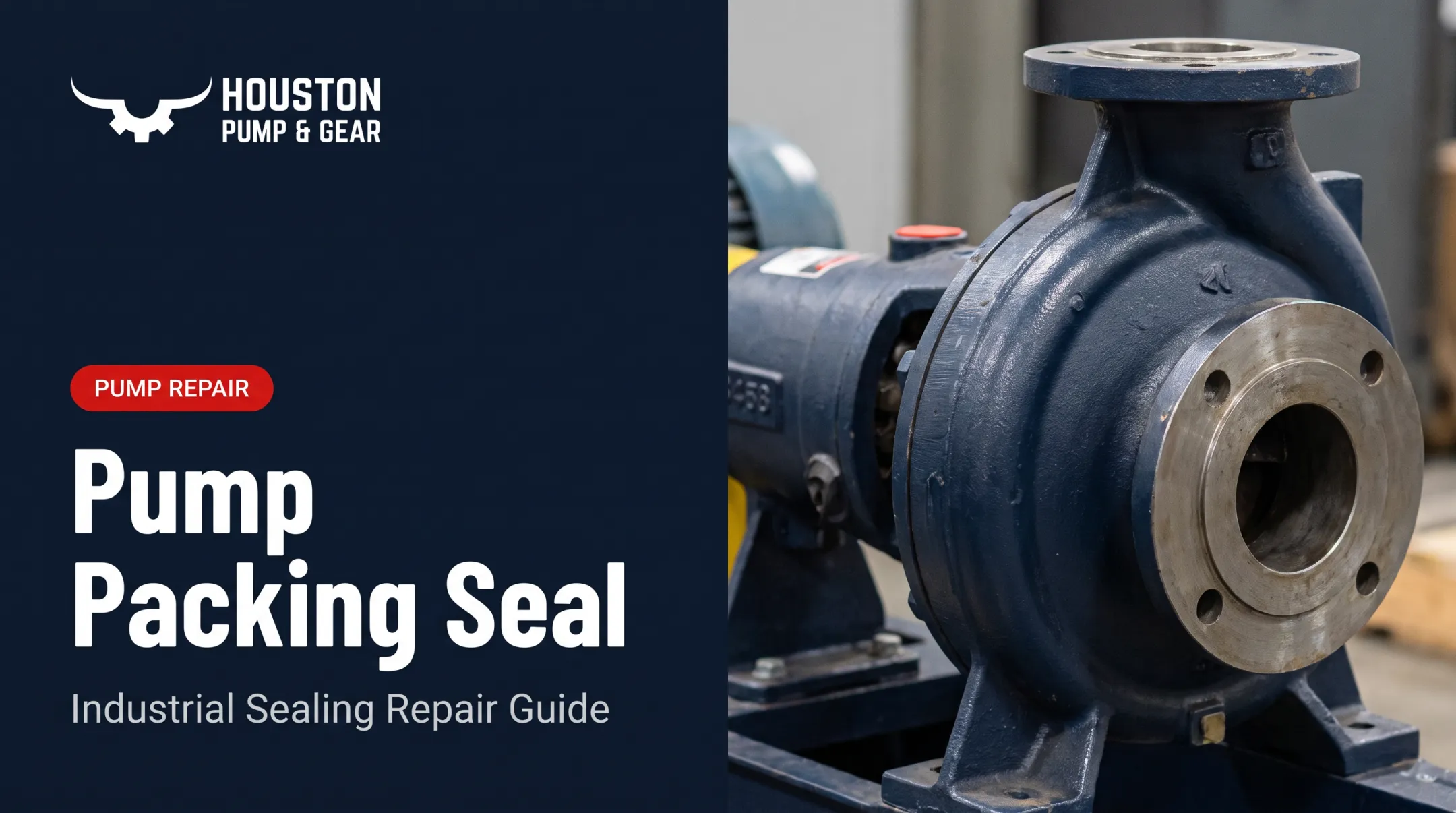
Gland packing consists of braided or molded rings, compressed inside the stuffing box around the pump shaft. A gland follower applies axial pressure against those rings, creating the sealing interface that keeps process fluid contained while the shaft rotates.
Its job is to control leakage, not eliminate it. Properly adjusted packing:
- Prevents air from getting sucked into the pump on the suction side
- Dissipates the friction heat generated at the shaft-packing interface
- Protects the shaft sleeve from direct wear
- Allows a thin film of fluid to lubricate the packing rings continuously
A small, steady drip is expected and necessary. Flowserve's own service documentation warns against tightening a packed gland until leakage stops completely, because that seepage is what keeps the packing from overheating.
Where Gland Packing Performs Best
Packing tends to outperform other sealing methods in specific conditions:
- Abrasive slurries (mining, mineral processing, dredging)
- Pumps with fluctuating shaft alignment or runout
- Applications where fast, simple field maintenance matters more than zero leakage
Core components referenced throughout this guide:
- Stuffing box: the cavity that houses the packing assembly
- Packing rings: the braided or molded rings that form the seal around the shaft
- Lantern ring: aligns with a flush port to introduce lubricating fluid
- Gland follower: applies compression to the packing set
Types of Centrifugal Pump Gland Packing Materials
Packing selection comes down to four variables: pumped fluid, temperature, pressure, and shaft speed. Get any one of those wrong, and you're looking at premature failure — often within weeks, not months.
Matching Material to Application
| Material | Approximate Limits | Best For |
|---|---|---|
| Acrylic/synthetic fiber | Up to 450°F, pH 4–10 | Clean water, light-duty general service |
| Aramid fiber | Up to 500°F, pH 3–11, 300 psig | Abrasive slurry, mining, mineral processing |
| PTFE composite | Up to 500°F, full pH range (0–14), 250 psig | Corrosive fluids, chemical processing |
| Reinforced graphite | Up to 1,200°F in steam service | Boiler feed, condensate, hot-water circulation |
Acrylic/synthetic fiber packings (and natural fibers like cotton) handle clean water and light-duty service well, but offer limited chemical or heat resistance. Don't use them near abrasive or corrosive media.
Aramid fiber earns its reputation in slurry and mineral processing environments. Its high tensile strength and abrasion resistance make it the default choice when pumped fluid contains solids.
PTFE composite is the go-to for chemical transfer lines. It's chemically inert across virtually the entire pH range, which matters when a pump handles anything from caustic to acidic streams.
For high-temperature service such as boiler feed pumps and thermal circulation systems, reinforced graphite is the standard. Chesterton's GraphMax packing is rated to 1,200°F in steam service, though that ceiling applies specifically to steam applications, not thermal oil or general process fluids.
Quick selection logic:
- Clean water, low temperature → acrylic or synthetic fiber
- Slurry or abrasive solids → aramid fiber
- Corrosive or wide-pH chemicals → PTFE composite
- High-temperature steam or boiler feed → reinforced graphite

Gland Packing vs. Mechanical Seals: Which Should You Choose?
This is the question every maintenance manager eventually asks. There's no universal winner. It depends entirely on the application.
Head-to-Head Comparison
| Factor | Gland Packing | Mechanical Seals |
|---|---|---|
| Initial cost | Lower | Higher, especially cartridge/double designs |
| Leakage | Visible, controlled (often several drops per minute) | Minimal to none when properly specified |
| Maintenance | Frequent adjustment, periodic repacking | Less frequent, more involved when it happens |
| Failure pattern | Gradual: wear and rising leakage give warning | Can be gradual or sudden, depending on the failure mode |
| Runout tolerance | Higher | Lower; needs precise shaft alignment |
According to AESSEAL, correctly adjusted packing typically leaks around 1 drop per minute per inch of shaft diameter, while a well-specified mechanical seal shows no visible leakage at all. That leakage gap is often the deciding factor.
When Packing Wins
- Abrasive slurry service where solids would chew through seal faces
- Pumps with significant shaft movement or misalignment
- Facilities that need fast field repairs without specialized tools
When Mechanical Seals Win
- Zero-leakage requirements (environmentally sensitive or hazardous fluids)
- Long-run operations where infrequent intervention matters more than upfront cost
- Applications where precise, repeatable sealing outweighs simplicity
Many industrial facilities run both technologies side by side, matching the sealing method to each pump's criticality and duty cycle.
Switching between the two isn't a five-minute job. It usually means checking stuffing box dimensions and shaft sleeve condition to confirm a mechanical seal will fit and perform. That evaluation is the kind of work Houston Pump & Gear handles as part of a broader pump overhaul.
Installation Best Practices for Gland Packing
Here's an uncomfortable truth: most premature packing failures come from installation mistakes, not bad material. You can buy the best aramid packing on the market and still burn through it in a week if it's installed wrong.
Get these fundamentals right:
- Clean the stuffing box thoroughly: leftover debris, old packing fragments, or corrosion will damage new rings immediately.
- Inspect the shaft sleeve: scoring or wear on the sleeve surface will chew through fresh packing fast.
- Install rings one at a time: never stack the full set and push it in together.
- Stagger the ring joints 90 to 120 degrees apart around the shaft, so no single leak path lines up through the stack.
- Apply even gland pressure: a cocked or unevenly tightened gland compresses the rings unevenly and creates hot spots.
One more thing that trips people up: don't over-tighten immediately after installation. Give new packing a short break-in period with slightly elevated leakage before snugging it down to normal operating range.
Houston Pump & Gear's field guidance on this mirrors what several manufacturers recommend. Tighten gradually, roughly half a turn on the follower nuts every ten minutes, rather than cranking it down all at once.

Troubleshooting Common Gland Packing Problems
When packing acts up, the symptoms usually point pretty directly at the cause.
Common symptoms and what they usually mean:
- Excessive leakage: Loose gland or packing wrong for the application. Past roughly 20 drops per minute, pull and replace the packing instead of keep tightening the gland.
- Overheating or burnt packing: Overtightening or insufficient lubrication. Some leakage is required; choke it off and you remove the cooling film the packing needs.
- Shaft or sleeve wear: Abrasive packing or an incompatible sleeve material. Tag each ring by position when you remove it—the wear pattern across the stack shows where the real problem sits.
Never layer new packing over old material still in the stuffing box. It looks like a quick fix, but the same failure typically returns within one to two months.
If you repack the same pump every few months despite doing everything right, it is no longer a packing problem. Shaft misalignment, a worn stuffing box, or bearing wear is usually driving the failures. No amount of repacking fixes that.
When Packing Problems Signal a Bigger Repair Need
Persistent leakage, recurring overheating, or visible shaft wear despite correct material and installation almost always means something upstream of the packing is broken. Bearings, alignment, the stuffing box bore itself: repacking won't touch any of that.
Here's how the escalation typically plays out. After removing failed packing, technicians clean the stuffing box and inspect the shaft directly. If that inspection turns up abnormal wear or damage, the shaft shouldn't go back into service as-is. At that point, options include:
- HVOF metal spray restoration to rebuild worn or corroded shaft surfaces back to spec
- Precision machining to restore dimensional accuracy
- Reverse engineering for obsolete or hard-to-source shaft and sleeve components
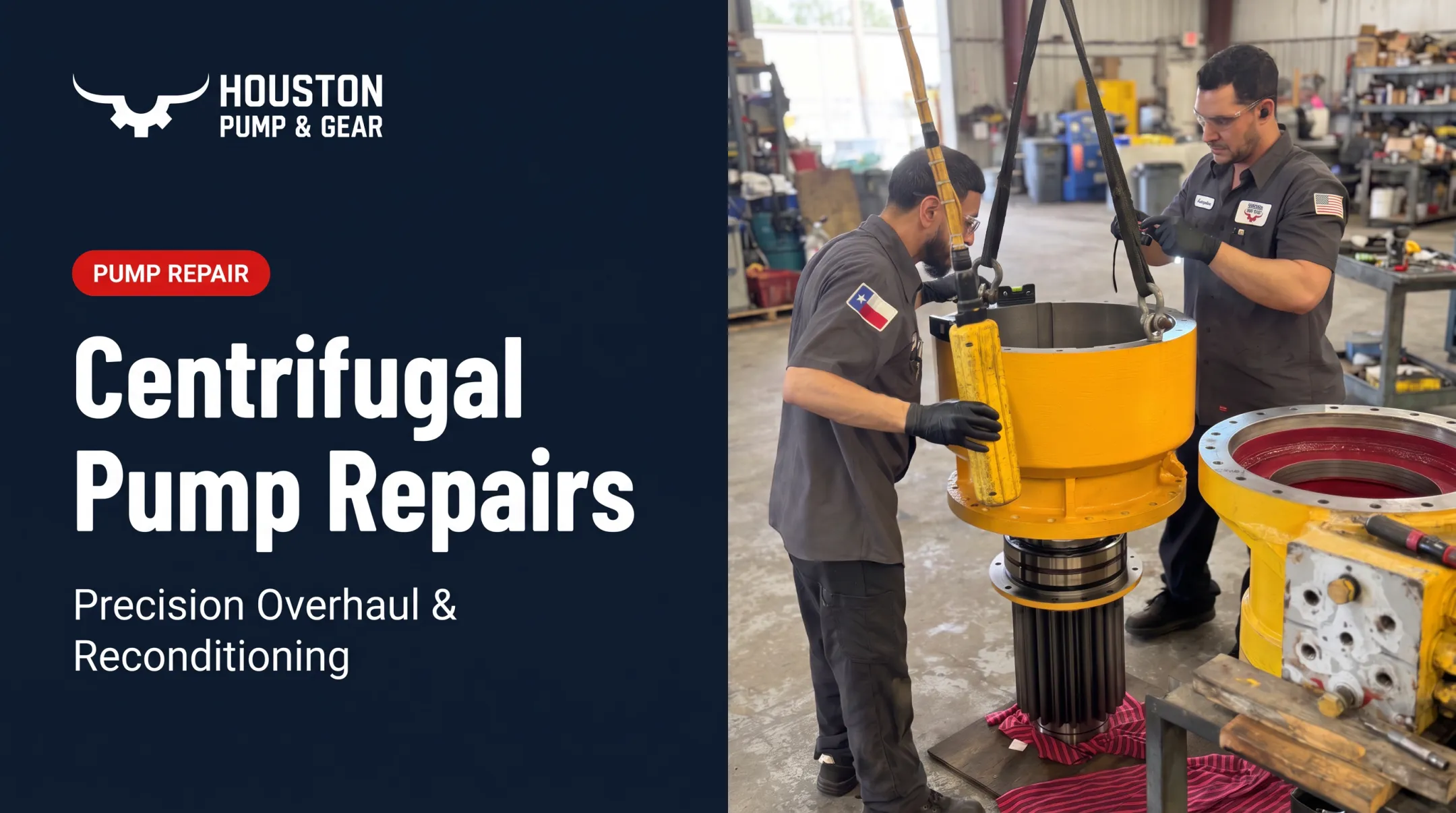
This is where Houston Pump & Gear's role shifts from advice to hands-on repair. We run 24/7 emergency response for power plants and heavy industry facilities across Texas and Louisiana, with mobile field pickup available when equipment needs to come off-site for full evaluation.
Speed matters once packing failure exposes deeper damage. When one long-term client's Lufkin S2212C gearbox went down in an emergency shutdown, our team picked it up the same day and had the plant running again within 72 hours. That relationship has since grown to more than 15 serviced units. Facilities should expect that same turnaround when a sealing problem points to shaft damage or other repairs beyond a simple repack.

Frequently Asked Questions
What is the purpose of gland packing in a centrifugal pump?
Gland packing controls shaft leakage rather than eliminating it, keeping air out of the pump while lubricating and cooling the shaft-packing interface through controlled seepage.
What types of seals are used in centrifugal pumps?
The two main categories are gland (compression) packing and mechanical seals. Packing comes in several material variations, including aramid, PTFE, and graphite, chosen based on fluid and temperature.
Which is better for a centrifugal pump: a mechanical seal or gland packing?
It depends on the application. Packing suits abrasive fluids, high shaft runout, and budget-conscious applications, while mechanical seals fit zero-leakage or high-reliability requirements.
How often should gland packing be replaced?
There's no fixed calendar interval. Replacement is condition-based. Watch for rising leakage rates, visible wear, or overheating as your key triggers.
Can gland packing be installed without removing the pump shaft?
Yes. Packing installation typically doesn't require shaft decoupling, which is one of its practical advantages over many mechanical seal installations.
What causes a pump to leak excessively through the packing?
Common causes include a loose gland adjustment, worn-out packing, the wrong material for your fluid, or a damaged shaft sleeve. Ruling each one out systematically usually identifies the cause quickly.