
That's where gear restoration comes in. Instead of waiting months for a manufacturer to build a replacement, restoration repairs the gearbox you already have — often in a fraction of the time and cost.
This guide covers when restoration makes sense, how the repair process actually works, and what to look for in an industrial gear repair partner.
Key Takeaways
- Restoration often costs far less than replacement — one power-generation case: $90,000 to restore vs. $300,000 new
- Severity of damage determines eligibility; not every worn or cracked gear can be saved
- 24/7 emergency response and mobile pickup shrink downtime from failure to repair start
- Post-repair hardness checks, dimensional inspection, and spin tests confirm long-term reliability
What Is Gear Restoration and Why It Matters
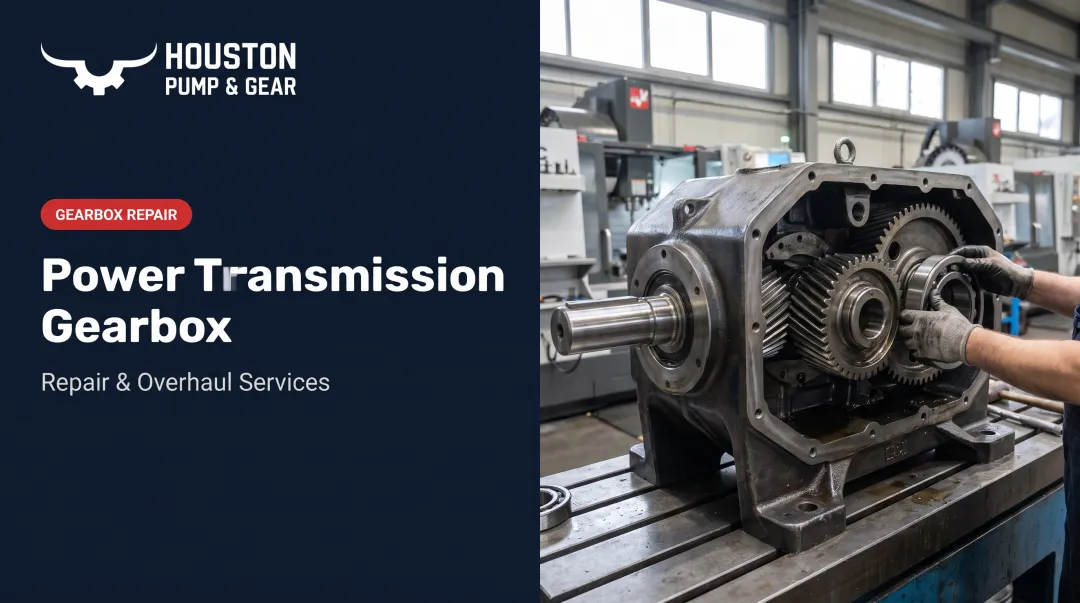
Gear restoration is the process of repairing worn, cracked, or damaged gear teeth and gearbox components instead of building an entirely new unit. It covers everything from machining worn tooth surfaces to rebuilding hubs and replacing bearings, restoring the gearbox to reliable operating condition.
Gears are the mechanical backbone of power transmission systems. When one fails inside a gearbox driving a turbine, compressor, or cooling tower fan, the entire line stops. There's no partial output — it's on or off.
Lead time is what makes restoration the practical choice. A documented Philadelphia Gear case involved a power-generation customer whose gearbox failed after 30 years without a full oil change. The rebuild took 8 weeks and cost $90,000, compared with 26-30 weeks and $300,000 for a new unit — roughly 70% lower direct cost in that case (Philadelphia Gear).
That gap matches what Houston Pump & Gear sees in the field. Original-manufacturer repairs often run 16-18 weeks, and a completely new unit can take 8-10 months.

Speed matters even more in an emergency. When a Lufkin S2212C gearbox failure triggered a shutdown at one power plant, the facility was back online in 72 hours rather than months.
Common Types of Industrial Gears That Can Be Restored
Most gear types found in power plants and heavy industry are restoration candidates when caught early:
- Spur gears: simple parallel-shaft designs used in auxiliary drives
- Helical gears: smoother-running gears common in enclosed industrial reducers
- Bevel gears: transfer power between shafts that meet at an angle
- Worm gears: high-torque, right-angle drives with built-in braking
- Internal/ring gears: used in planetary and epicyclic assemblies
- Large custom gearbox assemblies: Lufkin-style units, double helical, herringbone, and hypoid configurations

Signs Your Gearbox Needs Restoration vs. Replacement
Not every damaged gearbox is a restoration candidate. Catching problems early expands your options; ignoring them narrows those options to "replace."
Common wear indicators worth investigating:
- Worn or chipped teeth, surface pitting, or corrosion
- Unusual noise: clunking, grinding, or excessive vibration
- Overheating, oil leaks, or casing damage
- Reduced efficiency, slower output speeds, or inconsistent performance
When Replacement Becomes Necessary
Some failures are beyond economical restoration:
- Cracks or missing tooth sections that extend deep into the gear body
- Cracked housings
- Broken teeth that compromise structural integrity
A common industry guideline, the 75% rule, points to replacement once the repair estimate exceeds 75% of a new unit's cost.
Root fillet condition decides tooth resurfacing. The root fillet is the curved area at the base of each tooth, and it takes the brunt of bending stress.
If the fillet remains sound, machining and resurfacing the worn tooth face is often possible. Once fatigue cracking reaches the fillet itself, resurfacing will not hold. The gear needs deeper rework or replacement.
Core Gear Restoration Methods Used by Industrial Repair Shops
Restoration isn't a single technique. Repair shops choose the method based on damage type, gear size, and material.
Machining and Resurfacing
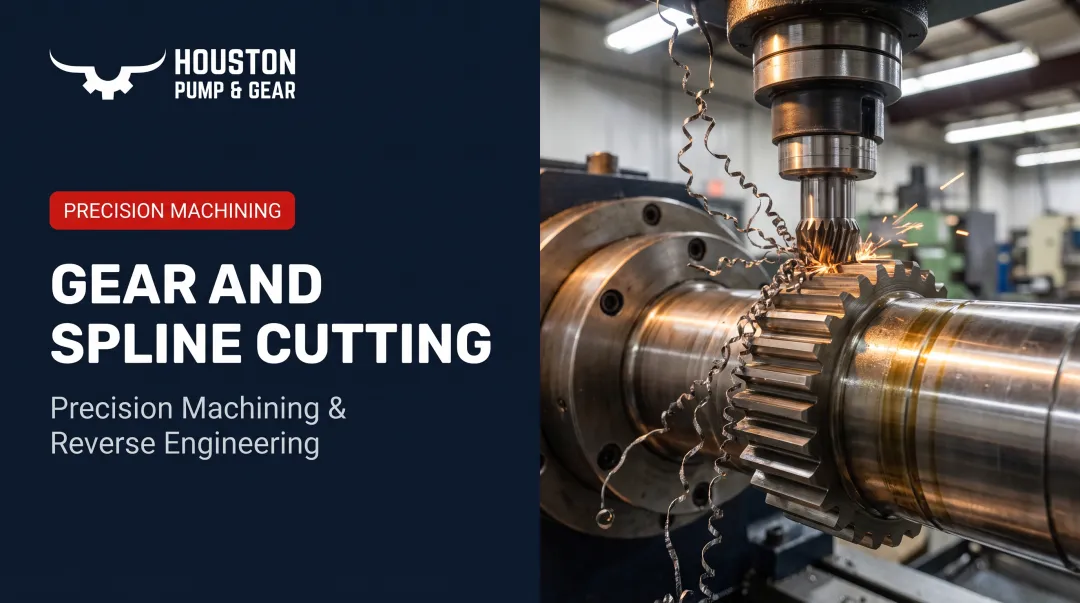
For gears with mild wear or deformation, machining shops can resurface worn teeth as long as the root fillets remain structurally sound. This is the least invasive, and usually fastest, repair path.
Welding and Rebuilding
Large gears with complex hub configurations may need weld-based rebuilding. For badly worn hubs, shrink-fitted pinned steel tire methods can restore the fit without remanufacturing the entire gear body. A peer-reviewed 2021 study on hard-facing repair found surface hardness comparable to new gears (58 ± 3 HRC). The tests used newly manufactured gears damaged for the study, not decades-old field equipment (PMC study):
- Weld repair works for controlled, well-documented damage
- Post-weld crack inspection is mandatory: x-ray and magnetic-particle (magnaflux) testing catch cracks invisible to the naked eye
- Tooth repair has limits: not every tooth profile or load case is a good candidate
Surface Treatment
Thermal spray and metal cladding (including HVOF metal spraying) repair significant surface wear on shafts and bearing journals. This route costs less and travels easier than full rebuilding, but coating parameters must match the actual load and material. One caveat: plastic and smaller precision gears use entirely different techniques, like plastic welding. Heavy industrial steel gearboxes require the machining and metallurgical approaches above — the two categories aren't interchangeable.

Quality Control and Testing After Gear Repair
A repaired gear is only as good as the verification behind it. Skipping this step is how "restored" gearboxes fail again within months.
Dimensional and hardness checks confirm the repair meets spec:
- Precision gauges verify tooth profile, backlash, and runout against original tolerances
- Surface hardness testing (Rockwell or Brinell) confirms the repaired area meets required hardness values
- Cross-sectional microhardness checks validate the metallurgy beneath the surface
Before returning to service, a reassembled gearbox should go through:
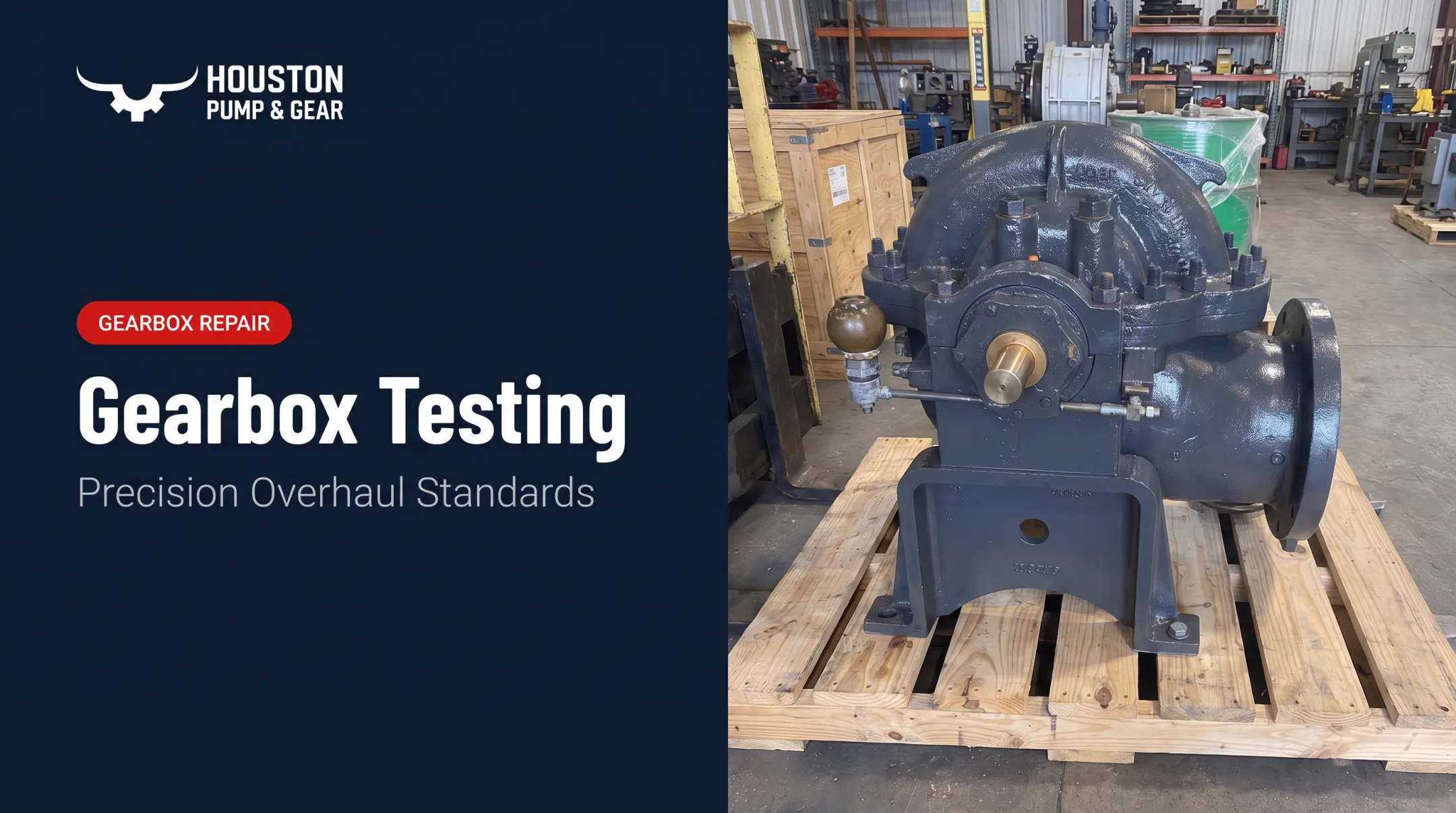
- No-load spin tests to confirm free rotation and correct speed
- Sound checks to catch abnormal noise
- Vibration measurement under load
- Bearing and housing temperature monitoring
- Full quality control sign-off before shipment

Houston Pump & Gear's 14-step overhaul process builds these checks in at every stage. The team identifies which parts can be repaired versus fully remanufactured, then load-tests the completed unit before it ships.
Why Rapid-Response Gear Restoration Matters for Power Plants
An emergency shutdown at a power plant burns money by the hour. That reality shapes everything about how restoration services need to operate.
Speed starts before the repair even begins. Mobile field response, a dedicated truck that picks up the failed unit the same day it fails, removes the delay between "gearbox down" and "repair underway."
When a Lufkin S2212C gearbox triggered an emergency plant shutdown, Houston Pump & Gear dispatched a truck the same day to retrieve the unit.
The plant was back up and running within 72 hours of the initial failure.
That kind of turnaround only happens with 24/7 availability, year-round. Gearboxes don't fail during business hours out of courtesy. They fail at 2 a.m. on a Sunday. An emergency repair partner needs to answer that call the same way they'd answer one at 2 p.m. on a Tuesday.
Choosing the Right Industrial Gear Restoration Partner
Not every machine shop can handle a large industrial gearbox under emergency conditions. Before you hand over a critical asset, look for:
- Proven experience with complex, large gearbox models such as Falk, Lufkin, Philadelphia Gear, and Horsburgh & Scott
- Mobile pickup capability to eliminate delay between failure and diagnosis
- A documented rapid turnaround track record, not just a promise
- Warranty coverage on parts and workmanship
Long-term relationships matter as much as any single emergency job. Consistent quality across repeated engagements builds the trust that matters when the next 2 a.m. call comes in. One Houston Pump & Gear client has had over 15 units serviced over the years.
Houston Pump & Gear operates 24/7 for emergency and long-term gearbox and pump service across Texas and Louisiana, working with power plants and heavy industry on everything from single emergency repairs to ongoing fleet maintenance.
Frequently Asked Questions
Can a stripped or cracked gear always be repaired instead of replaced?
Not always. Repair works well for wear, pitting, and moderate tooth damage, but severe cracks reaching the root fillet or missing structural sections typically require full replacement.
How long does emergency gearbox repair typically take?
Turnaround depends on damage severity, but a documented Lufkin S2212C emergency repair restored a power plant to service within 72 hours — a useful benchmark for urgent cases.
What is the cost difference between gear restoration and full replacement?
Restoration is generally far more economical, especially for large or custom units. One documented power-generation case showed $90,000 for repair versus $300,000 for a new gearbox — about 70% lower cost in that instance.
Can large industrial gearboxes like the Lufkin S2212C be restored?
Yes. Shops with the right machining equipment, welding capability, and testing infrastructure can restore complex industrial models, including large custom assemblies.
What quality checks happen after a gear is restored?
Repaired gears go through dimensional inspection, surface hardness testing, and a full test-run — including spin tests, vibration checks, and temperature monitoring — before returning to service.
Do gear repair shops offer emergency or after-hours service?
Some do. Houston Pump & Gear operates 24/7 with mobile pickup for emergency gearbox failures across Texas and Louisiana.